I doubt anyone on this forum is more disdainful of president Trump than I am. I try very hard not to let my bias in that regard to influence my opinions about the markets.
My view of Trump's influence on the economy and the markets are as follows: Long term, very bearish. Intermediate term, moderately to very bullish.
Trump is not the only factor to consider. AI is potentially an explosive influence on productivity (long term). Deficits (1.8 trillion estimated for 2025) is another long term problem (bearish). But in this post I am looking at the Trump influence.
The Fed is already leaning towards rate cuts. Now it appears that Trump is going to replace Chairmen Powell with a loyalist who will push for severely lower rates which is bullish the stock market. Of the 7 board governors who are political appointees, 4 are from Trump (so far). The balance of voting members come from regional bank presidents and serve on a rotating basis and are not political appointees. So with 12 voting members there is still some independence, but less and less.
Another move which I've read about is Trump's desire to lower the liquidity requirements for bank lending. Also bullish in the short to intermediate time frame.
Yet another short term juicing of the markets is Trump wanting to send out checks to voters which he describes as windfall money from the tariffs. Of course Trump's signature will be on every check just like during the pandemic, which caused inflation that helped sink Biden.
The Supreme Court will soon rule on the legality of the tariffs. Some people suggest if they rule against him it will be like a tax cut with money going back to companies (bullish). I'm not so sure
Think of Trump as the guy pouring more vodka in the punch bowl. He doesn't care about the resulting hangover. He'll be long gone when the disaster he causes will be upon us. But in the meantime, party on!
Comparisons to president Andrew Jackson, who was also a populist president who assaulted the National bank. I asked my friend ChatGPT if Jackson helped cause an economic contraction and how long did it take to unfold: Interesting comparison in my opinion.
Your contemplative/analytical posts are some of my favorites here! They always make great points, most of which I agree with and some that make me think more.
On future interest rates. Not only do I agree, it's also something that we've not been posting the impacts of enough here.
President Trump only appoints people that he rigorously vets as those that will follow his agenda. Competence is an after thought in the process and we can see the results everywhere. So the market knows that the new head of the Fed(with his previous appointees, will likely aggressively cut interest rates for him. Like you said, this will stimulate the economy, which is bullish the stock market for several reasons.
One of them is the fact that alternative investments will earn LOWER interest rates and this makes stocks more appealing. Another is, if memory serves me right, historically, the stock market is weak/bearish when interest rates are RISING, bullish when interest rates are falling which probably is related to this same principle but also related to the economic conditions at the time, which might be different this time because Trump wants lower interest rates............PERIOD. Never mind justification using the big picture or inflation considerations.
With regards to Trumps tariffs rebate checks. This is another quintessential example of why Trumponomics lacks even a basic grasp of economic principles as his tariffs blatantly violate them in profound ways and now, his impulsive, brand new idea to stimulate support from Americans for a ruinous tariffs policy(doubling down, like he often does) makes it even MORE ruinous.
Let's explain. He has falsely claimed that our trading partners pay the tariffs. No, they pay ZERO. It's all American companies that pay the tariffs. It's a big price hike on them. The cost of goods for AMERICAN companies goes higher. They have 3 choices after that:
1. Pass on the higher costs to consumers(inflation) or
2. Purchase less product, which causes less supply in the US(inflationary)
3. Eat the tariffs and make less money
Trump likes this because he gets to collect that money for the government and his lack of comprehension makes him oblivious to the rest, which includes LOSING massive business(longer term in some cases), going both ways with many of our key trading partners.
Trump has insisted the tariffs money would pay down the debt. That might be great if his Big Ugly Bill did not do the opposite. Now, he wants to give the tariffs money back to Americans. Hugh? Not only would this blow up the National Debt even more, as you mentioned this would be inflationary by itself but think about this.
It's a triple whammy for the following reason.
1. The tariffs cause prices to go up because US companies need to hike prices when they pass on their increased cost.
2. Or because they don't buy as many foreign goods which causes supply shortages(inflationary)
3. On top of that, putting more money in the hands of consumers would stimulate the economy. This last factor would impose a NEW inflationary pressure thats independent of the inflation caused from collecting the tariffs!
So Trump would be increasing inflation by collecting the tariffs, then increasing inflation even more when he gives the money back to consumers.
In the end, the government has nothing left to pay down the debt. Consumers get back some of the money they have to pay for higher prices but higher prices, because of the indisputable laws of economics will EXCEED the rebates.
It's the recipe for less buying power for consumers(AFFORDABILITY), less money left in the end for them and nothing for the government, while destroying the long lived, beneficial 2 way trading relationships with all of our trading partners.
Dial in lower interest rates and that's another inflationary factor which reduces consumer buying power even more.
In the end, this is really, REALLY bad news and a reckoning is inevitable. It's impossible to have a time table but the reality of basic economic principles which Trump doesn't care about(or can't comprehend) is impossible to avoid.
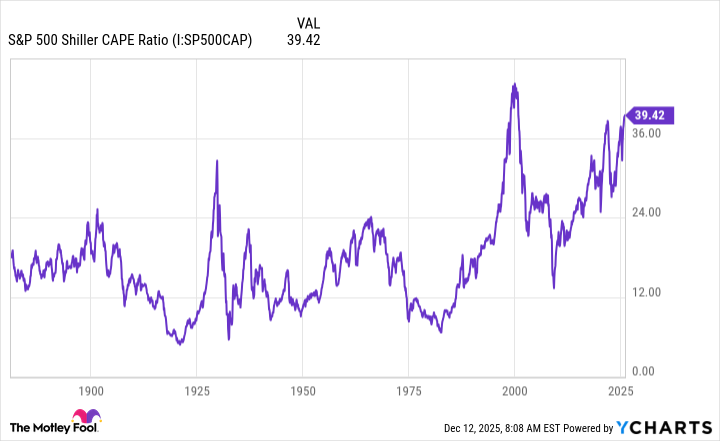
When back-tested to January 1871, the average multiple of the Shiller P/E is about 17.3. In late October, when the broad-based S&P 500 hit its all-time high, the Shiller P/E peaked at 41.2. The only time the market has been pricier is in the months leading up to the bursting of the dot-com bubble.
History shows that every time the Shiller P/E has surpassed 30 over the last 155 years, a decline of at least 20% has eventually followed for one or more of Wall Street's major indexes. While this valuation indicator isn't a timing tool, it does have a flawless track record of foreshadowing downside for the stock market.
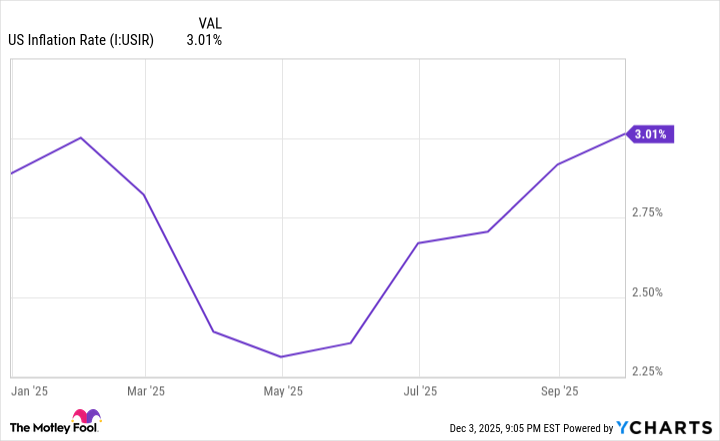
The U.S. inflation rate has been modestly climbing since President Trump implemented global tariffs. US Inflation Rate data by YCharts.
The Federal Reserve on Wednesday cut its influential interest rate for the third time this year, pointing to a job market that Chairman Jerome Powell said may be weaker than it appears.
The cut of a quarter point — a cautious interest rate move by the Fed — could make it cheaper for average Americans who hold a mortgage, have credit card debt or need to take out or refinance a personal loan. It would also help businesses borrow at lower rates.
But it comes at the risk of stoking inflation that has yet to fall to the Fed’s preferred levels. At a news conference following the Fed’s announcement, Powell said that tariffs were helping to keep inflation higher than it might be otherwise.
Given the Fed’s dual mandate of promoting maximum employment while keeping prices stable, any move the central bank makes comes with risks.
“There is no risk-free path for policy as we navigate this tension between our employment and inflation goals,” Powell said. “Our obligation is to make sure that a one-time increase in the price level does not become an ongoing inflation problem.”
The Fed chair said the committee decided to cut rates because of a number of factors.
“First of all, gradual cooling in the labor market has continued,” he said. “Unemployment is now up three-tenths from June through September.”
Powell also said the central bank believes that there has been an “overstatement” in recent jobs numbers of about 60,000 jobs. In his view, data showing that payrolls have been pacing at about 40,000 jobs added per month are, in fact, really pacing at 20,000 jobs lost per month.
++++++++++++++++
Tough spot for the Fed with the economy losing jobs (but Trump's people providing fake jobs data) at the same time that the Trump tariffs are keeping inflation too high.
Could this be the top in the stock market? Buy the rumor, sell the fact on the very expected drop in interest rates with tons of bad news continuing to bombard the market.
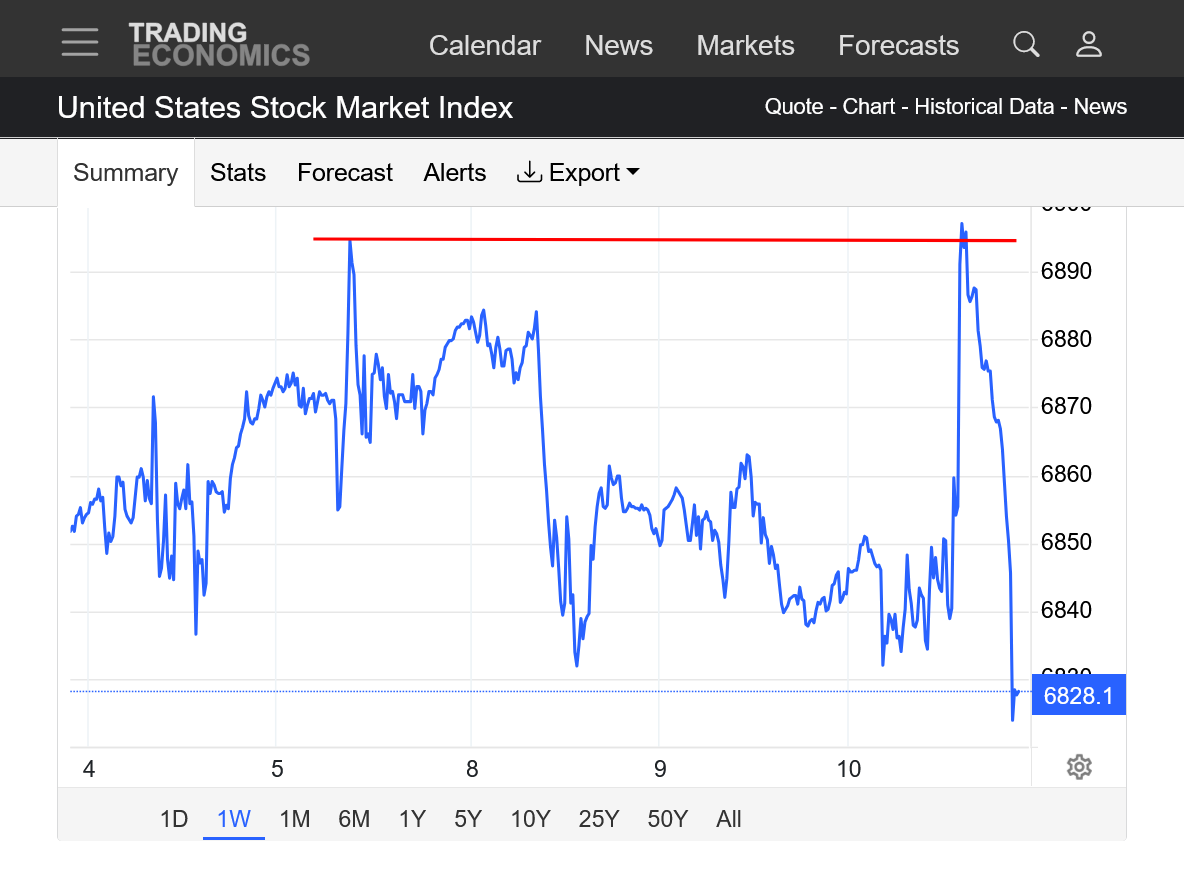
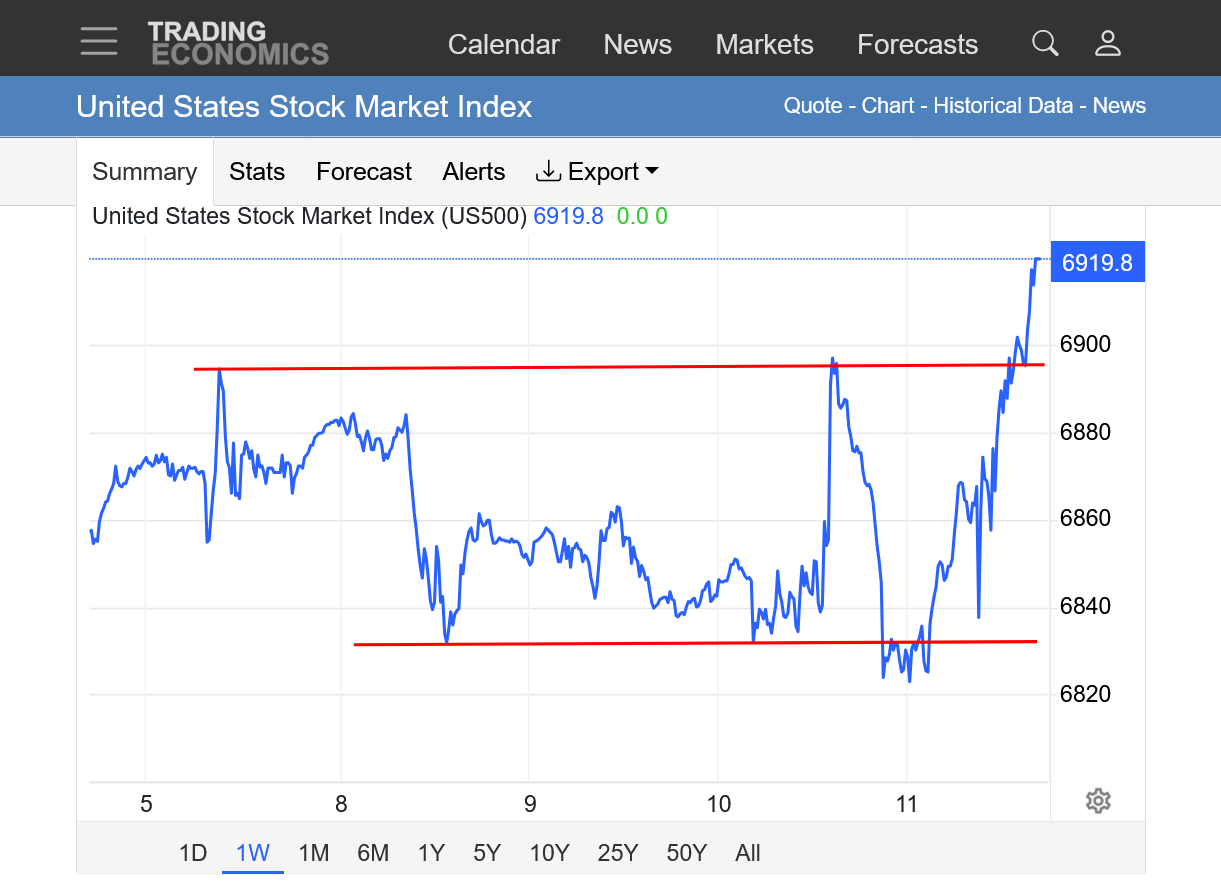
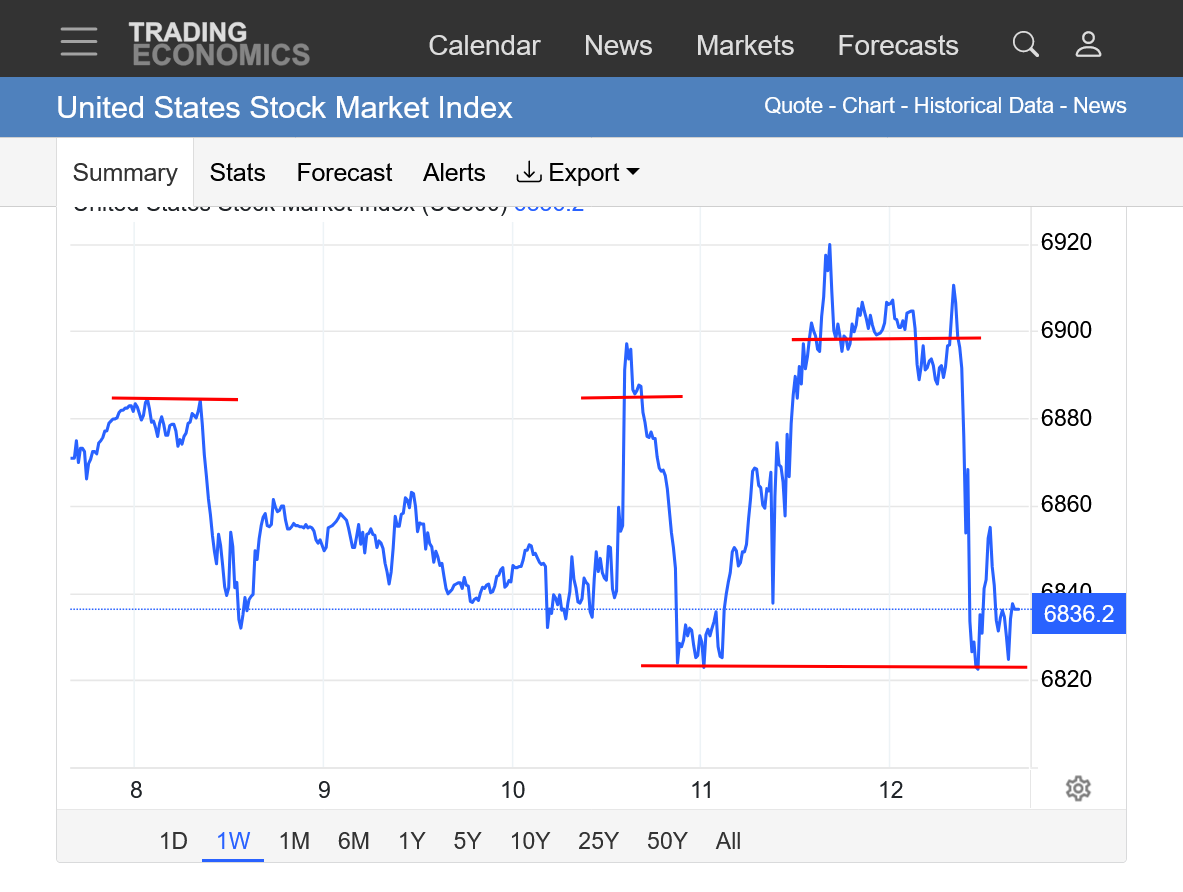
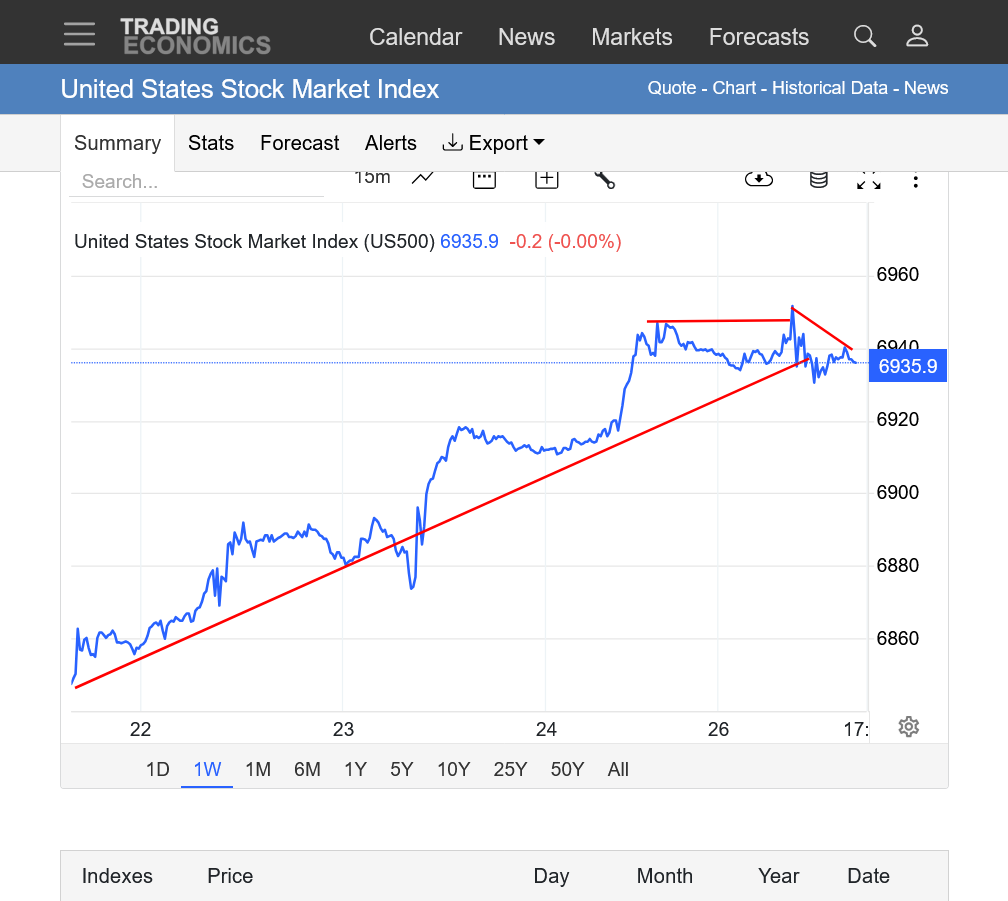
1. 1 week: Spike to new highs for the week on the news and reversing lower
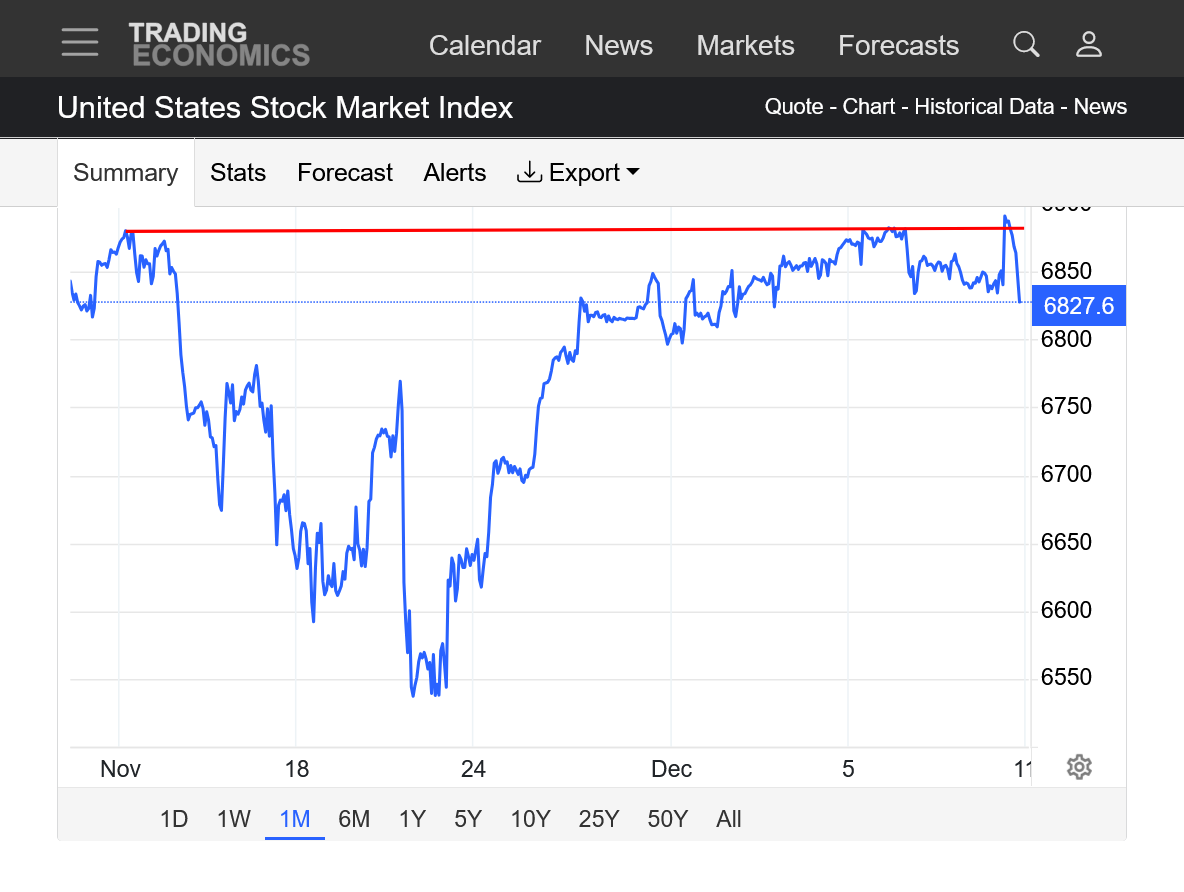
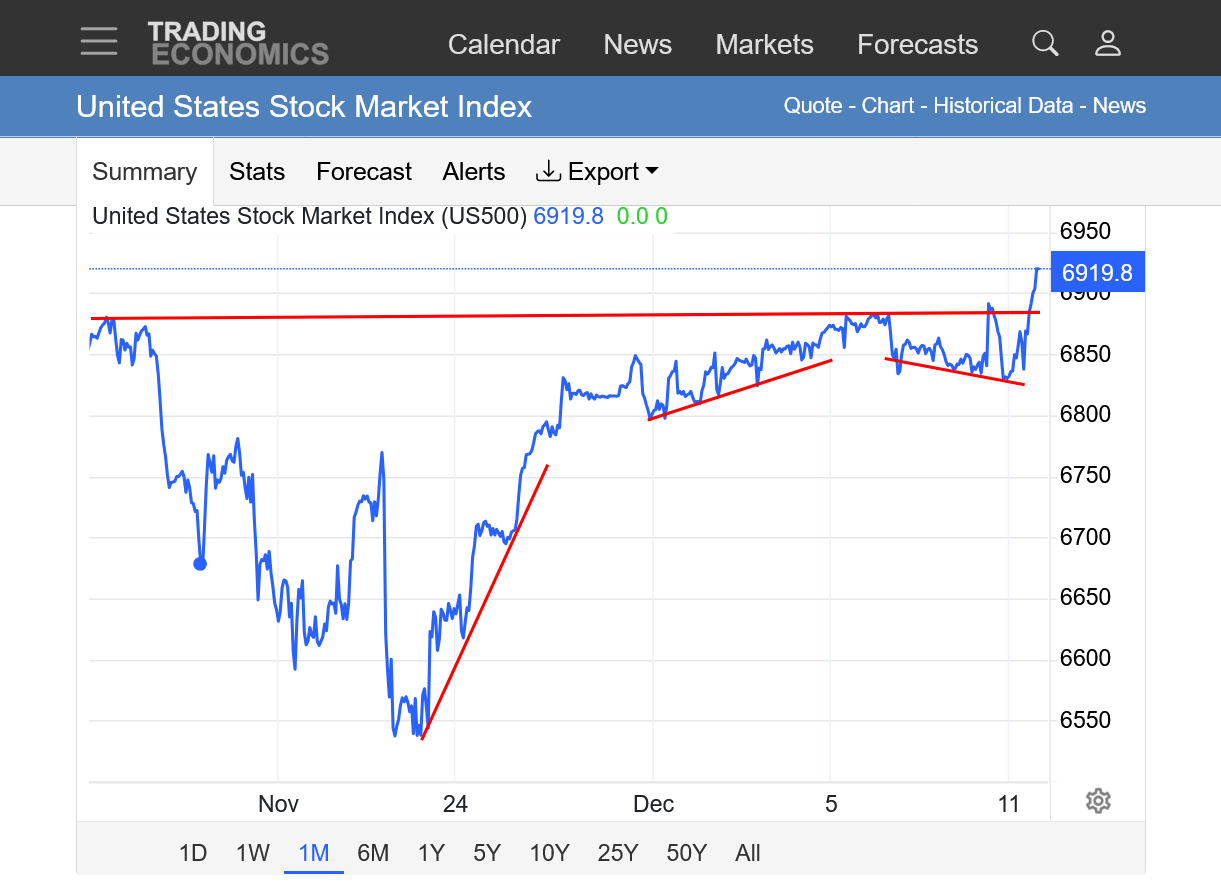
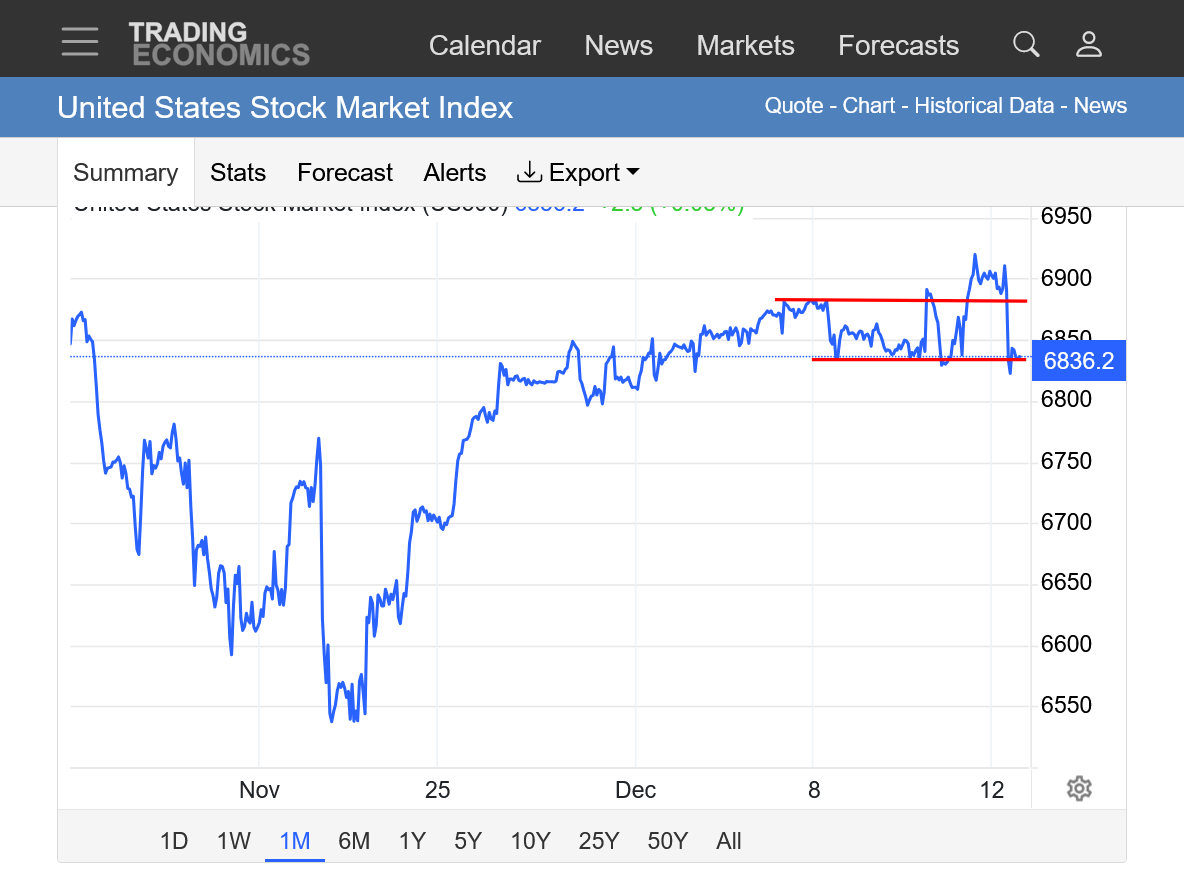
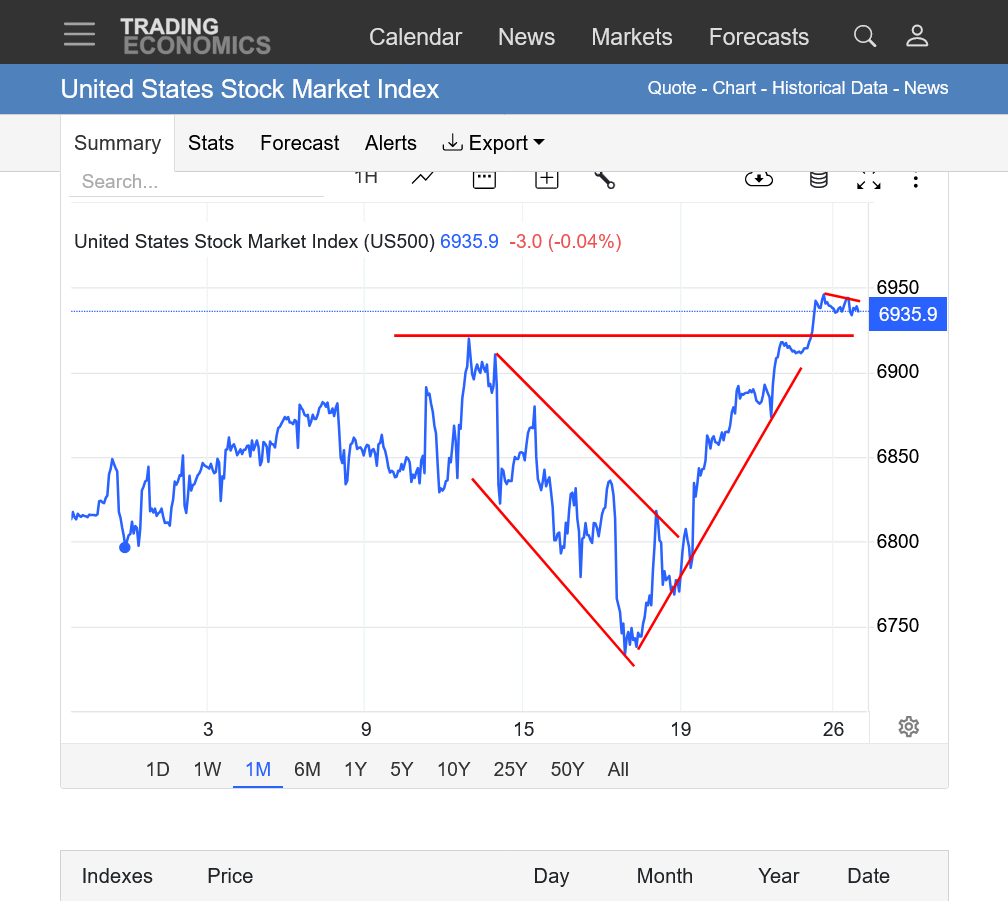
2. 1 month: Spike to new highs for December and reversing lower
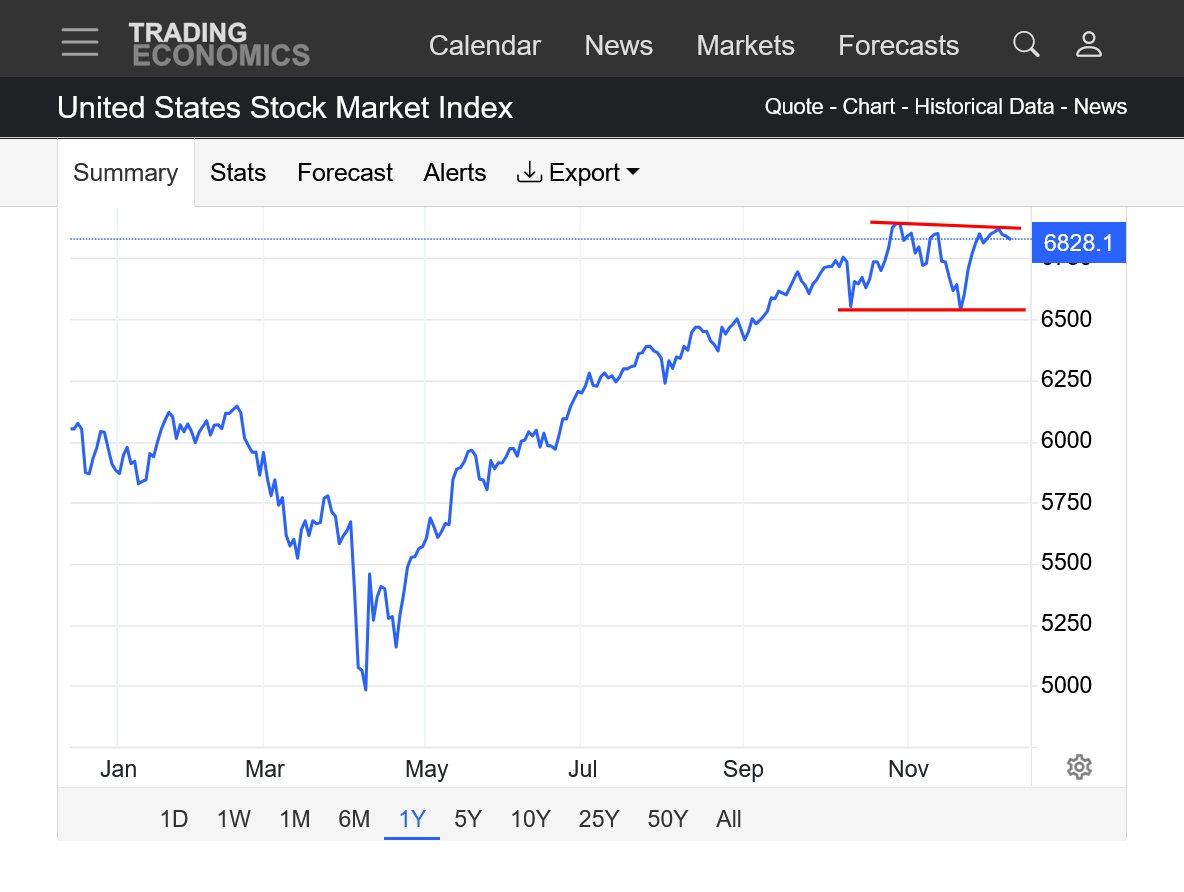
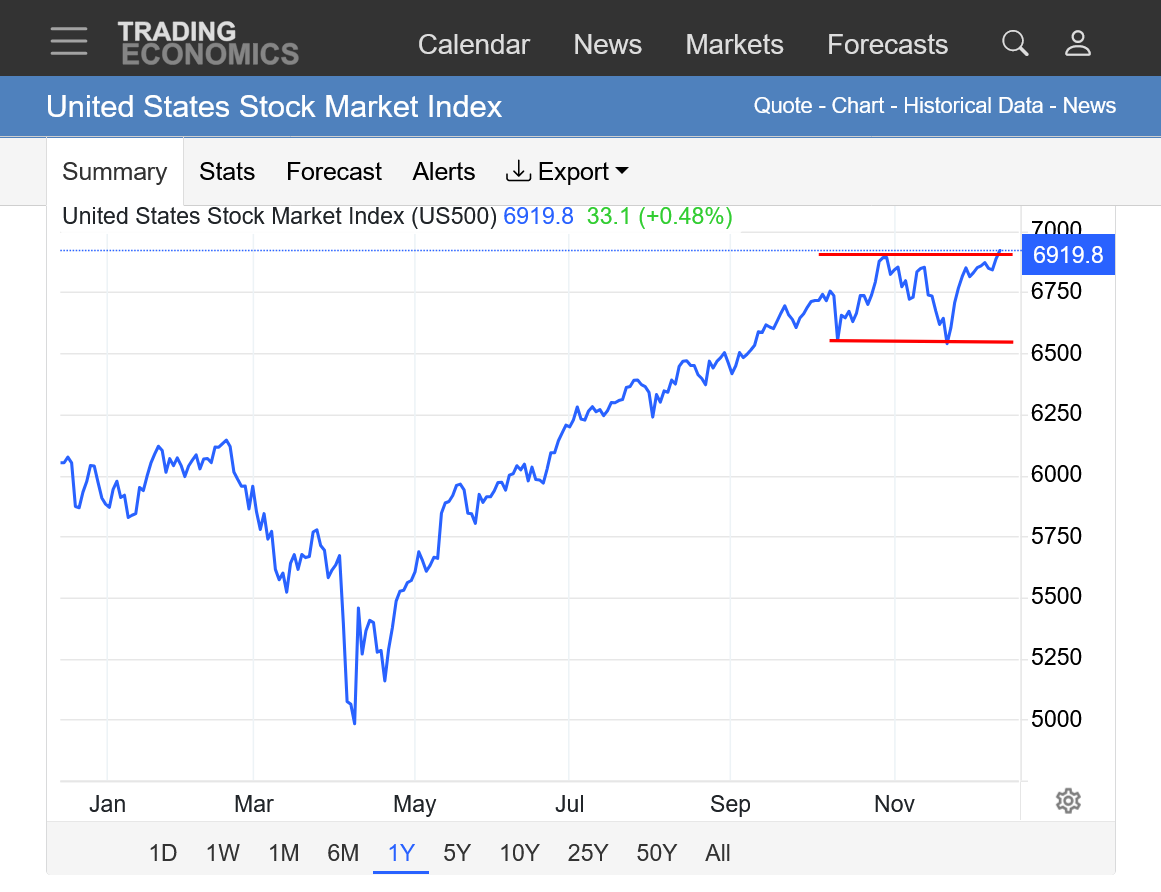
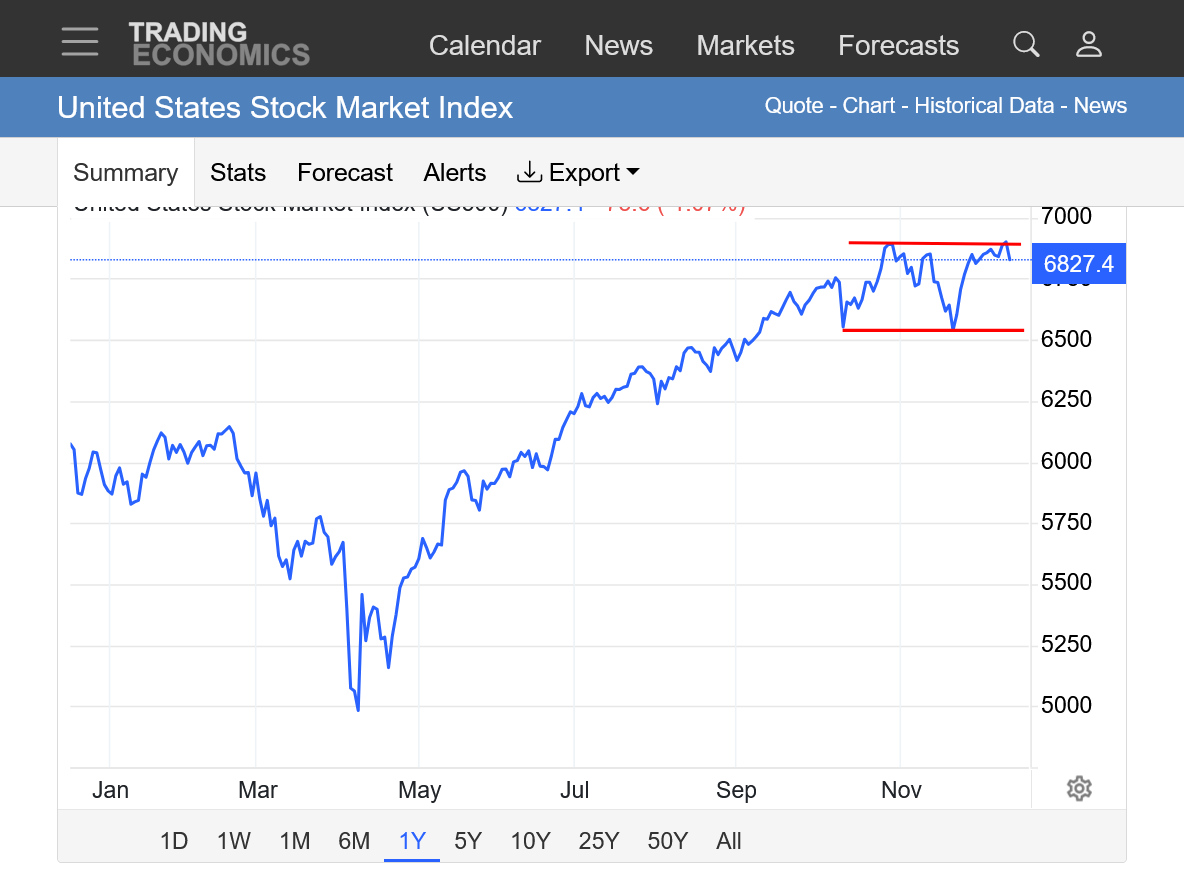
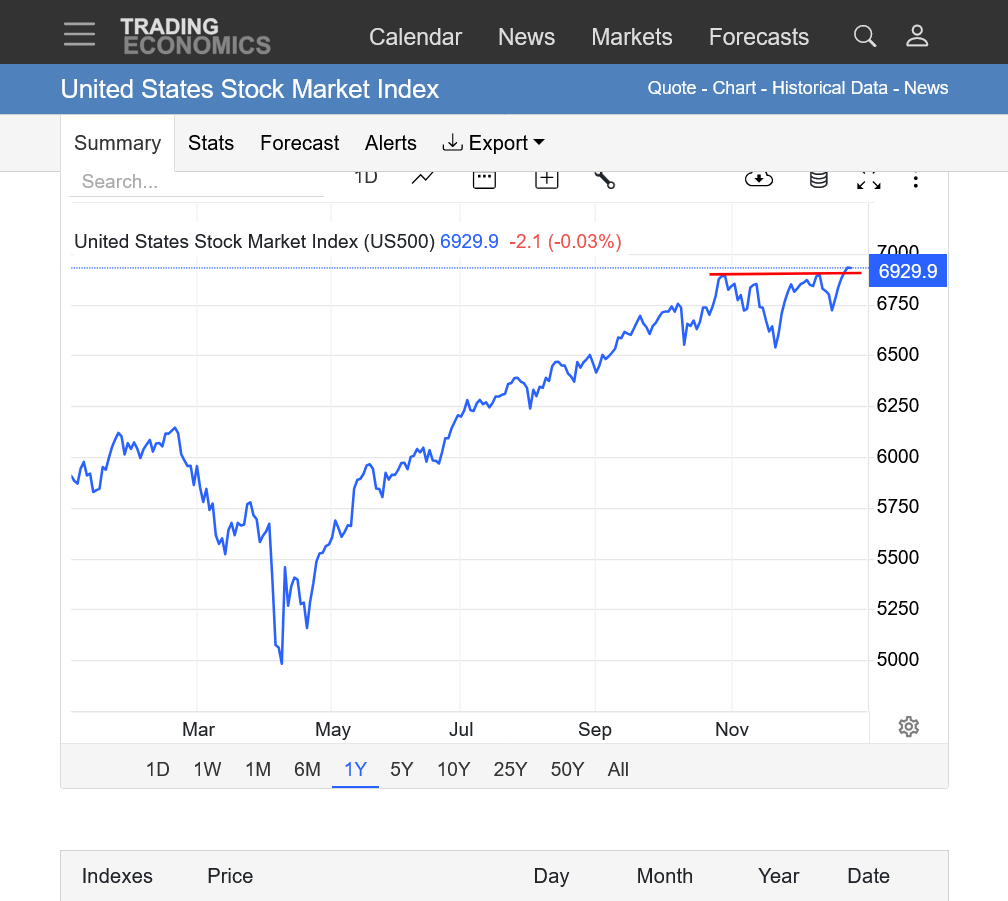
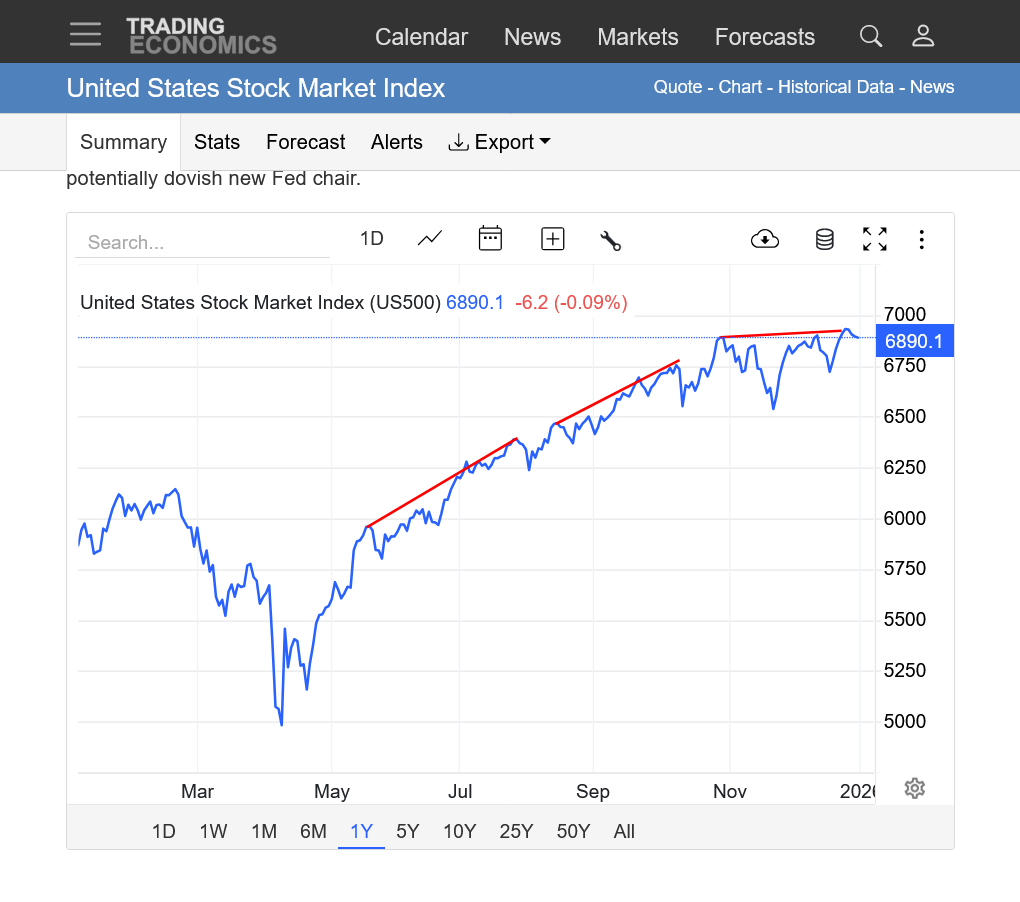
3. 1 year: Double/Triple top? We need new highs to negative that and instead confirm this as a bull flag/continuation pattern.
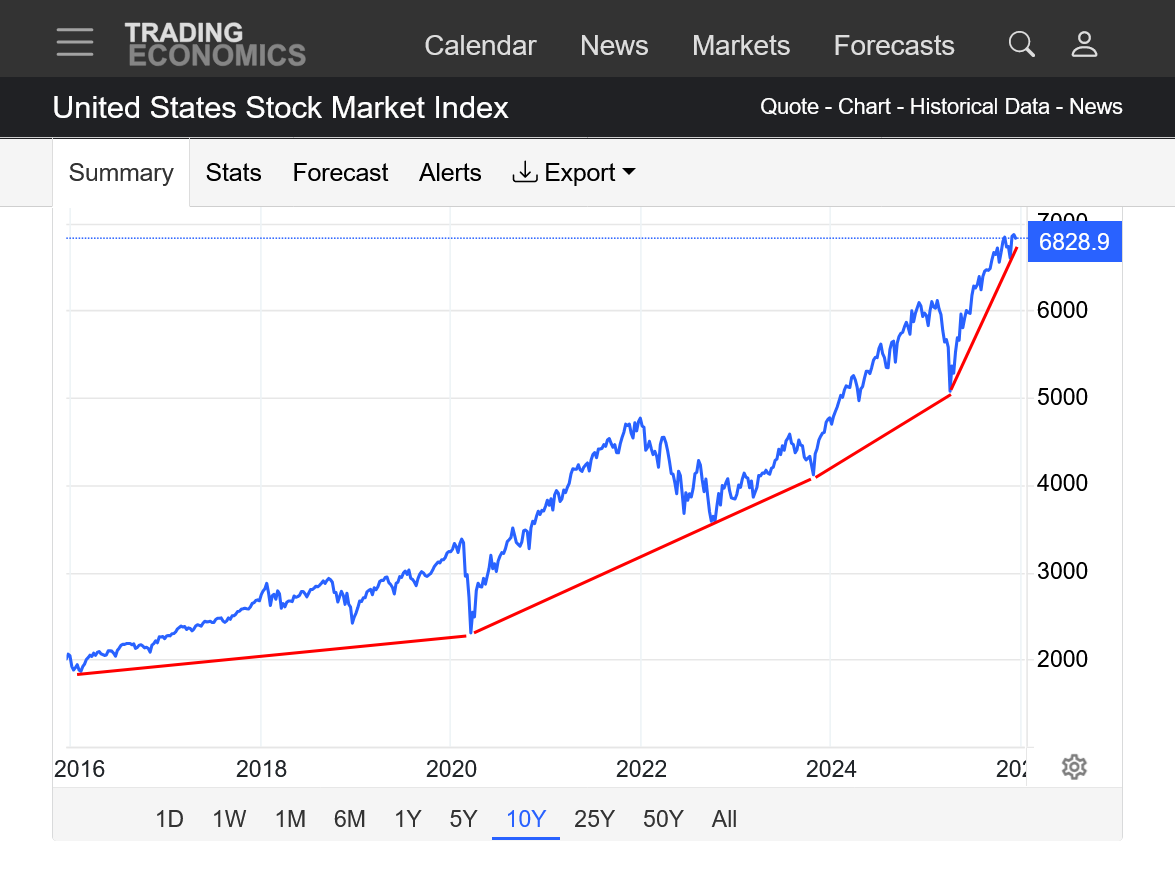
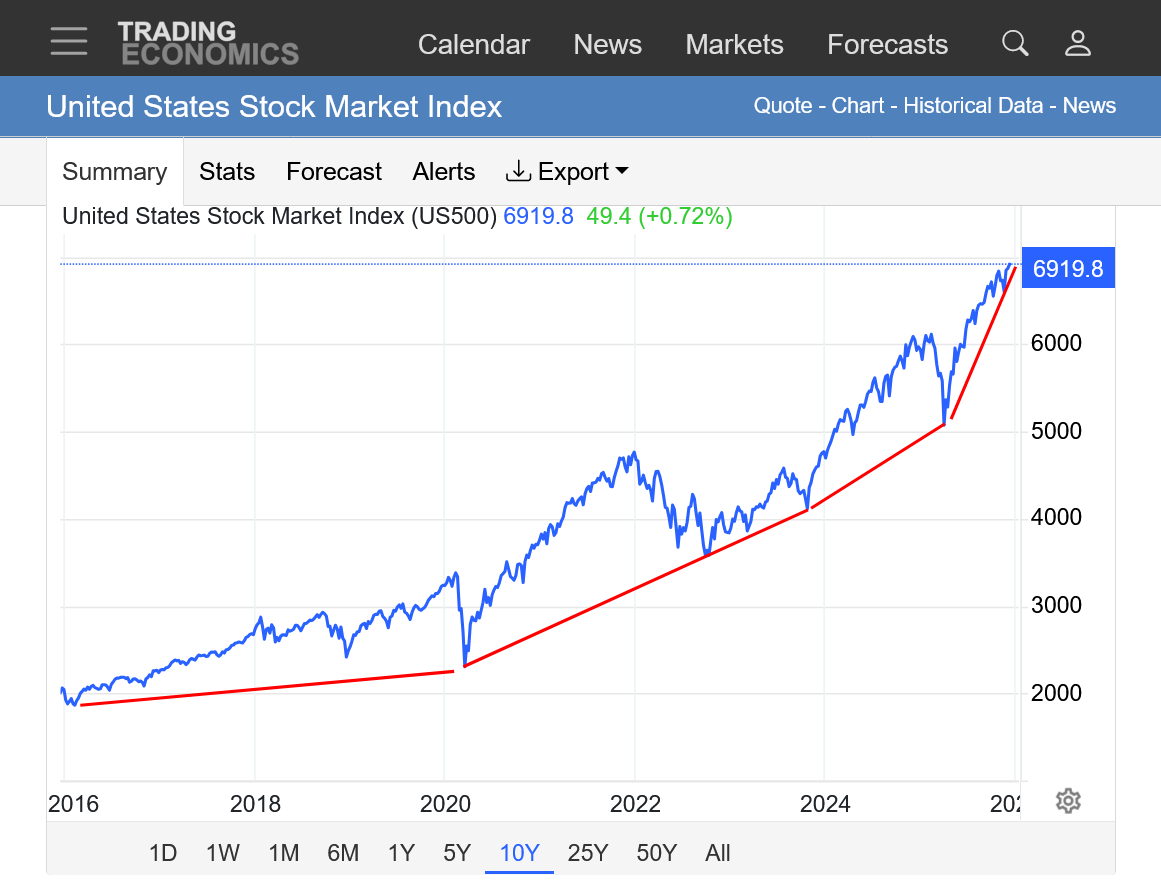
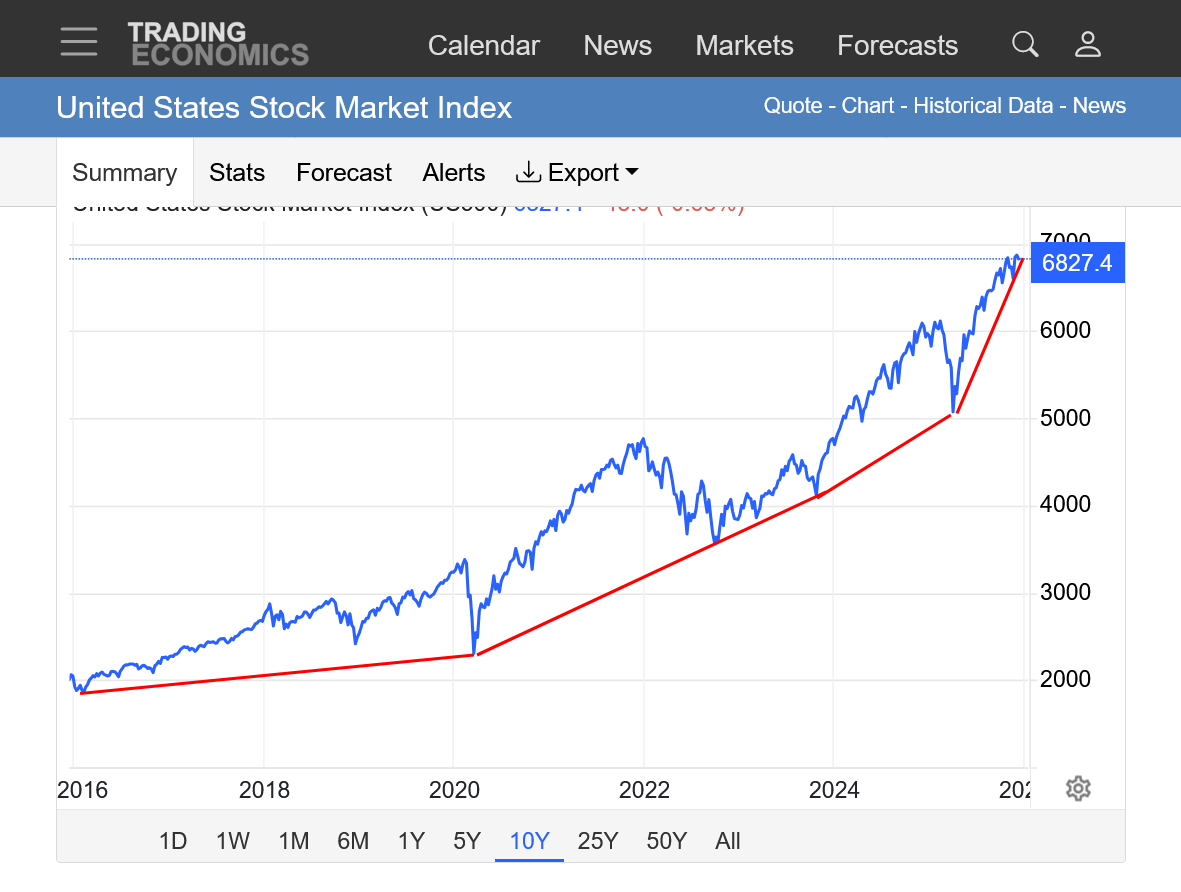
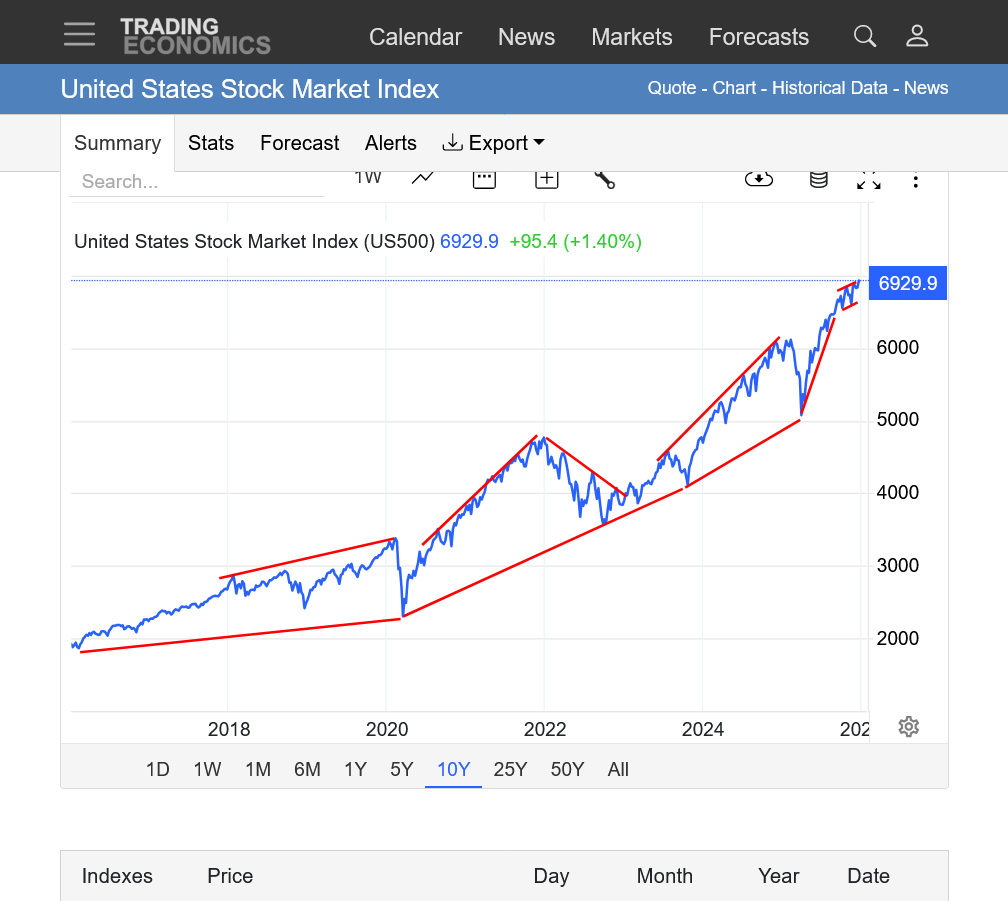
4. 10 years: Parabolic/exponential move higher with a steeper and steeper, unsustainable uptrend. Impossible to know when it will end.........until it ends.
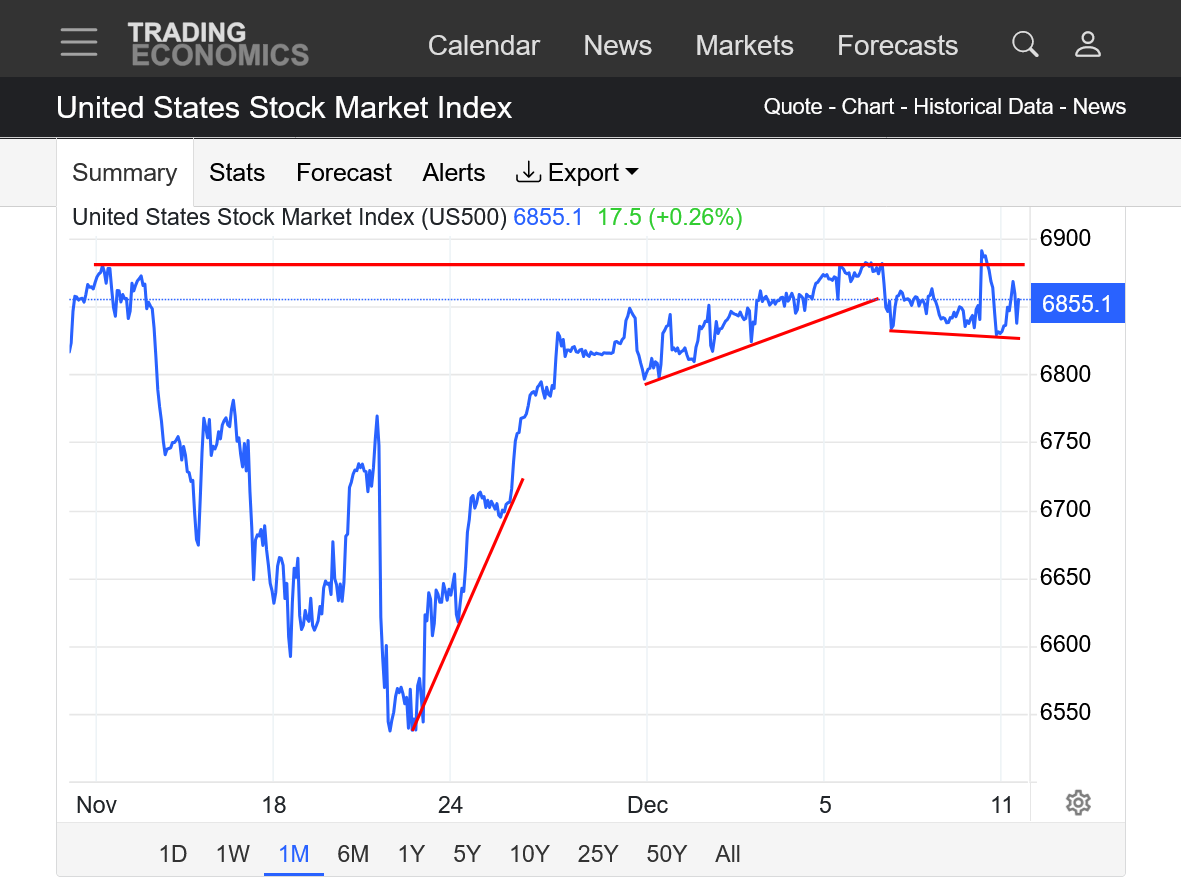
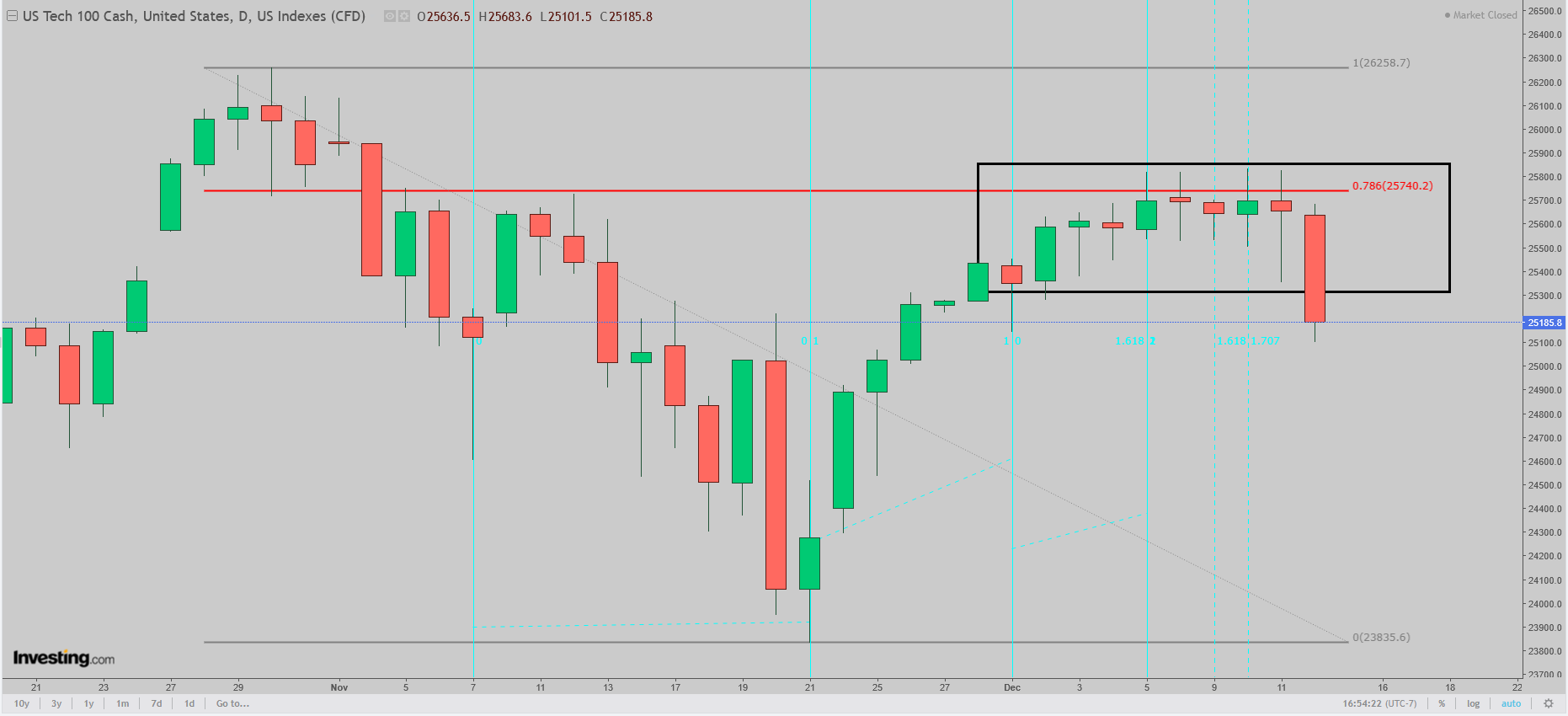
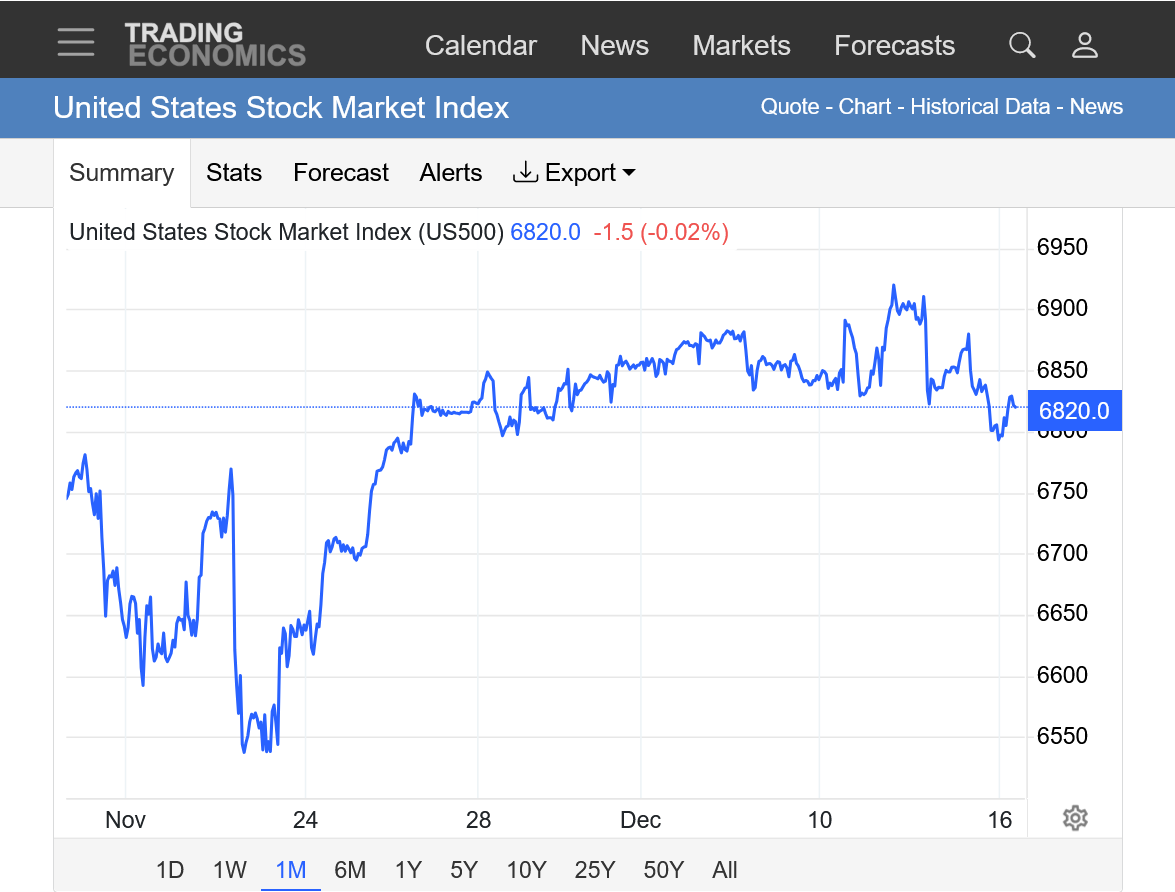
1 month: Staying in a tight range below MAJOR resistance/highs but still with much more bullish overall formations. Red lines only tell us what has already happened and how the markets reacted at specific prices/times based on what Wyckoff's "Composite Man" knew at those moments.
But the market is only right at those moments. If it was always right..........the price would never change. This means the market is usually wrong and a trader's objective is to figure out whether the market is too cheap or too expensive. Magnitude can be important but DIRECTION is by far the most important.
+++++++++++++
Wyckoff lived at a different, simpler time that could never have envisioned what our computers do with advanced analytics and data.
He was not a day trader either. But he was a genius at understanding market action.
Some of these principles are constantly violated in the markets. The only one that matters at any point in time is whether the vast majority of active traders that PLAN TO BUY OR SELL, think the current price is too low or do they think its too high.
Wyckoff’s first rule tells traders and investors that the market and individual securities never behave in the same way twice. Rather, trends unfold through a broad array of similar price patterns that show infinite variations in size, detail, and extension, with each incarnation changing just enough from prior versions to surprise and confuse market participants. Cryptocurrency traders would call this a shapeshifting phenomenon that always stays one step ahead of profit seeking.
The second rule: Market relativity, tells us traders and investors that context is everything in the financial markets. Thus, the only way to evaluate today’s price action is to compare it to what happened yesterday, last week, last month, and last year.Analyzing a single day’s price action in a vacuum will elicit incorrect conclusions.
”…all the fluctuations in the market and in all the various stocks should be studied as if they were the result of one man’s operations. Let us call him the Composite Man, who, in theory, sits behind the scenes and manipulates the stocks to your disadvantage if you do not understand the game as he plays it; and to your great profit if you do understand it.” — Wyckoff
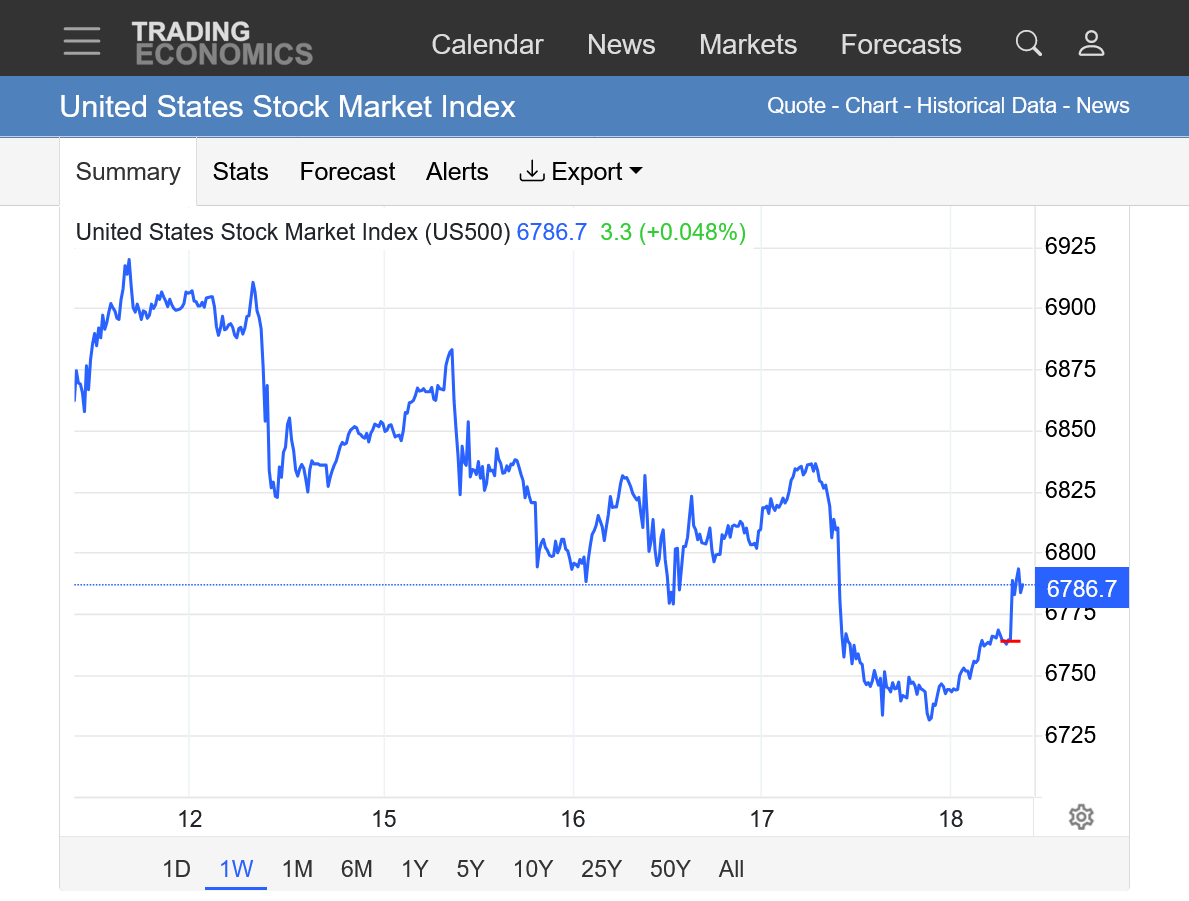
1. 1 week: After making record highs we spiked/reversed down and closed on the lows for the week. Note that every time the market made new highs, this week it was rejected with lower prices immediately. The market is unable to attract fresh buying at these overpriced levels. A gap lower on Sunday Night would put in an extremely bearish chart formation. If I traded stocks, this would be a selling set up.
2. 1 month: FAKE UPSIDE BREAK OUT from a bull flag! Instead, we are threatening to break out to the DOWN side of the sideways trading wedge formation.
3. 1 year: Double top? Still bullish trend right now.
4. 10 years: Parabolic/exponential move with steepening/increasing slope. Prices have far outdistanced valuation. At some point, they WILL have a major correction lower. Still bullish long term trend right now.
* The above chart is the NQ daily, after spending a week going nowhere while trying to close above the 0.786 retracement level from the recent decline (10/30 H - 11/21 L) the market reversed course and is close to the 12/01 low
* If we close below the 12/01 low we could see additional down side in a C wave fashion
* Other indexes on the other hand went to new all time highs
* The Nasdaq however often leads all indexes both up and down .... !
* Do I believe this being THE top ...? Not yet but the markets will decide in due time
President Trump has imposed International Emergency Economic Powers Act (IEEPA) tariffs on US trading partners, including China, Canada, Mexico, and the EU. In addition, he has threatened and imposed Section 232 tariffs on autos, heavy trucks, steel, aluminum, lumber, furniture, semiconductors, pharmaceuticals, and copper, among others.
The Trump tariffs amount to an average tax increase per US household of $1,100 in 2025 and $1,400 in 2026.
Under the tariffs imposed and scheduled as of November 1, the weighted average applied tariff rate on all imports rises to 15.8 percent, and the average effective tariff rate, reflecting behavioral responses, rises to 11.2 percent—the highest average rate since 1943.
The Trump tariffs are the largest US tax increase as a percent of GDP (0.47 percent for 2025) since 1993.
Historical evidence and recent studies show that tariffs are taxes that raise prices and reduce available quantities of goods and services for US businesses and consumers, resulting in lower income, reduced employment, and lower economic output.
Canada Lays the Groundwork to Pivot Away From the United States
While Trump’s tariffs and “America First” unilateralism are reshaping relationships around the world, nowhere has the effect been more profound than in Canada. The country’s response so far has been energetic and ambitious. But as U.S. tariffs start to bite—Canada’s economy shrunk by 1.6 percent in the second quarter of 2025 largely due to falling exports, and its unemployment rate ticked above7 percent in August—it is clear the hurdles are daunting.
The fallout has forced Canada to develop a new plan to face down an antagonistic United States. It is built on three pillars: unifying its economy domestically, bolstering military spending, and seeking deeper ties with European allies. Each involves a radical break with the past.
Canada’s strategic realignment will require time to gradually reduce its economic and military dependence on the United States and foster new relationships in Europe and Asia. Slower economic growth is likely for several years at least. Carney has so far had strong public support in his efforts to deal with what he called last week “not a transition [but] a rupture” in Canada’s relationship with the United States—but he may not get all the time he needs.
Trump Tariffs on Australia and New Zealand Risk U.S. Pacific Strategy
Joshua Kurlantzick is senior fellow for Southeast Asia and South Asia at the Council on Foreign Relations.
Australia and to a lesser extent New Zealand are central to U.S. defense strategy in the Western Pacific. U.S. strategy, which has remained consistent through the Presidents Joe Biden and Donald Trump administrations, aims to deter China’s expanding reach into the airspace and waters of the Pacific. This relies on building a network of partners in the region that allow operational access, possess sophisticated weapons, and are sites the Pentagon can count on to help deploy U.S. planes, ships, or ground forces in the event of a conflict.
Now, however, the Trump administration’s trade policy toward Canberra and Wellington has put defense ties with the two normally stalwart allies at risk. Both countries, where the U.S. has become extremely unpopular, are now openly considering foreign policy shifts away from Washington.
In addition to the tariffs’ economic effects, U.S. trade policy is threatening other key aspects of relations with Australia and New Zealand: high-level “Five Eyes” intelligence sharing; popular support among policymakers and the general publics for U.S. ties and a rules-based global order led by the United States; and joint efforts to prevent Chinese influence from proliferating within democracies as well as in Pacific Island states that have become essential in the case of a potential Pacific conflict.
++++++++++++++++++++
These are actually all no brainer, always destined to happen consequences from Trump's tariffs based on the indisputable economic and trading principles between country's. There are no economists anywhere that I've read who advocate for tariffs and they all give the same reasons and negative consequences. The tariffs were imposed entirely because of our president's pathological thinking and complete lack of comprehending what almost every economist in the US(and world) understands.
++++++++++++++
There is no magical mystery trading wand to wave over markets in the form of tariffs that equal the imbalances between rich and poor countries. This is completely made up by Trump.
Those differences, actually ARE BENEFICIAL FOR BOTH SIDES!
The country that can manufacture/produce the cheapest goods and most efficiently has the incentive to do that with BOTH countries benefiting tremendously. The producing country AND the other country's companies that can buy those products CHEAPER and without tariff taxes and sell it to consumers cheaper and at a higher profit for that company which increases GDP and reduces inflation. This free trade encourages both countries to buy products that the other ones specializes in with each other. For example, soybeans and agriculture products that our farmers are so good at producing and are competitive at selling on the global market when markets are allowed to trade freely.
The tariff/trade war with #1 global soybean importer, China messed over our country when they shunned our soybeans and bought Brazil and Argentina soybeans, even when they were higher priced than US soybeans.
Our soybean farmers were very competitive but Trumps tariffs completely shut down that business with China.
Dozens of other countries are making permanent changes to replace the US business as mentioned above. Trump's tariffs and especially, his wildly erratic and inconsistent application of them make agreements with Donald Trump NOT dependable. This is isolating the United States and reducing business on both sides of the trading equation.
This hurts both countries but it especially hurts the United States that pays higher prices, our companies and consumers (since we foot 100% of the tariff bill) and at the same time, it reduces the amount of our exports. It especially hurts smaller companies here too that pay much more for their products/raw materials because of the tariffs on them. This means less sales and also results in them being forced to cut costs by reducing labor/employees.
This is so basic to economic laws which rule, especially when rich and poor countries trade and there is almost always a huge trade imbalance. Trump, unfortunately instead of appointing qualified people/economists to give him solid economic advice, has sought out only people that have pledged their allegiance to him because his main priority is to do whatever he wants without being challenged.
It will be interesting to see what the Supreme Court rules. If they were smart, objective and not political and not worried about the extreme chaos and push back from Trump, it's absolutely clear they should rule the illegal tariffs to be illegal based on Trump's manufactured emergency (bypassing the Constitutional requirement of approval from Congress).
The absurdity of Trump declaring a trade imbalance that's benefiting both sides and FAKE emergency to justify his ruinous tariffs, imposing a massively damaging policy(tariffs) to the United States, breaking something badly (free trade) that doesn't need to be fixed to line up with his manufactured narrative is insane.
This by itself is 1 trillion times worse than the 1 phone call that he placed to Zelensky in 2018 that insanely got him impeached by the diabolical Ds in the House. He just wanted to get the truth about the Biden family's blatantly corrupt activities in Ukraine while Joe was using his position as VP to enrich the Biden's.
Trump did 0 damage to anybody with that phone call!
With his tariffs, if you add it all up globally, it's well into the TRILLIONS with a T.
Tariffs, inflation and policy uncertainty are doing the heavy lifting
Behind the numbers, the forces dragging on growth are increasingly familiar: tariffs, sticky prices and policy cross‑currents. Market strategists describe the current cycle as one defined by instability, with trade measures and their uneven application distorting supply chains and profit margins in ways that show up in both corporate earnings and household prices. In that view, tariffs and their uneven application are not just a background annoyance but a central reason why growth is fragile and market swings are sharper than usual.
++++++++++++++
Tariffs are a particularly bad way to raise revenue
In this explainer, I show why tariffs are a particularly bad way to raise funds for the U.S. government.2 The United States raised roughly $30 billion in tariff revenue in August. Trying to make this a permanent revenue stream will be costly. It will hurt consumers. It will hurt the U.S.’ most productive firms. It will reduce economic growth. And, it will undermine U.S. relationships around the world.
President Trump routinely claims that foreigners pay his tariffs, which is false—U.S. importers pay them. Over time, however, foreign exporters can be expected to bear a small but rising burden of the tariffs through price cuts, while most of the cost will be borne by U.S. consumers in the form of higher prices.
"Going back for generations, Canadians have visited New Hampshire and many other states along the U.S.-Canada border to see family or friends, stay in our hotels, share a meal at our restaurants and shop at our stores," Hassan said in a statement.
"However, in the wake of President Trump's reckless tariffs and needless provocations, fewer and fewer Canadians are making trips to the United States, putting many American businesses in jeopardy and straining the close ties that bind our two nations."
'Long-lasting damage'
In Washington state, the number of passenger vehicles crossing the border was down 24 per cent and cities like Spokane reported a 33 per cent drop in visitors. Ridership on the Clipper Navigation ferry service between Vancouver Island and Seattle was down 30 per cent, forcing the company to lay off a quarter of its workforce.
Businesses in New York also reported cutting employees. For example, the North Country Chamber of Commerce, which serves the northern part of the state, reported in June that 83 per cent of businesses in the area had noticed a drop in Canadian customers, leading 35 per cent to cut staffing.
"Seventy per cent of businesses blamed the political climate and tariff policies for this drastic decrease," says the report.
Some business owners, like Christa Bowdish of the Old Stagecoach Inn in Vermont, who was forced to lay off employees and reduce hours, told the committee she feared the damage will be lasting as Canadians find other destinations.
"It's not just the tariffs," she said in the report. "This is long-lasting damage to a relationship and emotional damage takes time to heal."
++++++++++
Hedging against Trump, Canada reconsiders ties with China
India with its 1.46 billion people is the most populous country in the world with 18% of the global population.
Its the fastest developing country and has a lot of brilliant people which makes it inevitable as the worlds next super power with estimates of India’s GDP by 2050, surpassing the United States.
Hopefully, the next president will repair the damage done by Donald Trump to our relationship with them and the many dozens of other countries in the world that have lost much of their respect for the US and no longer trust us, so they are shunning the previous long term relationships and trust that we had previously. between us.
This isn’t just speculation. It’s happening. Read the articles and multiply that by many times as Donald Trump applies his toxic leadership based,on pathological thinking to foreign affairs.
I can provide thousands of examples in different realms of this. Not only do I not have TDS, as I’ve noted here numerous times, I voted for Donald Trump in 2016 and 2024 and defended him with many hundreds of posts in his first term and during the corrupt weaponizing of the justice department in NY targeting him.
This is completely independent of that and a crisis for our country because of his progressive dementia which has brought out a diabolical element to Donald Trump imposed on already delusional(and getting worse) thinking that was controlled by Congress and a less deranged man in his first term.
This is not personal. It’s based entirely on objective analysis of the authentic facts using the scientific method.
This comment is NTR. For 3 days after the employment numbers were released I searched Fox "News" for the reporting of the poor employment numbers. Nothing! They simply don't report bad news. Finally, yesterday on Fox, my search revealed this:
"Trump administration confident in economy despite new jobs report".
The NY Times, Washington Post and Wall Street Journal ALWAYS report the jobs numbers, whether they are good or bad. How can anyone defend Fox as a news source? They are a propaganda arm of the MAGA cult.
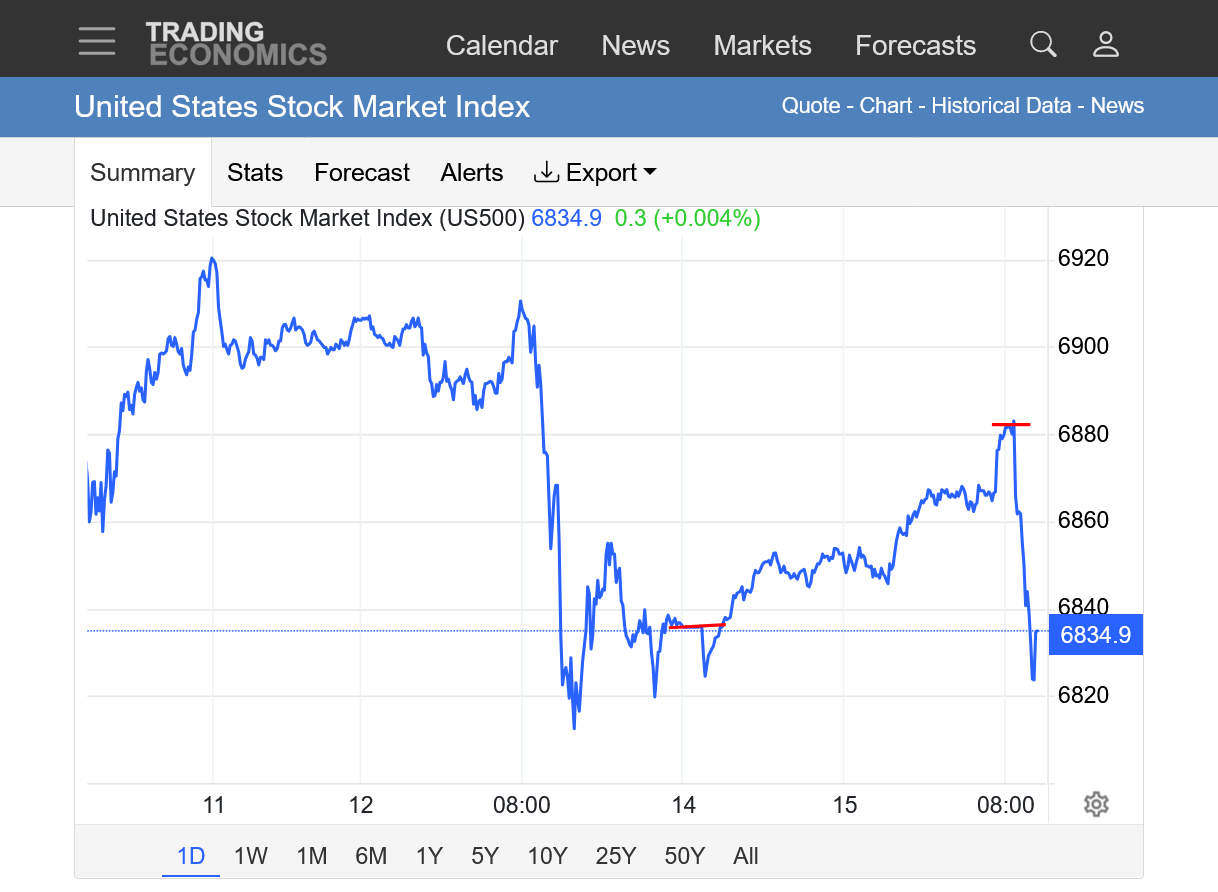
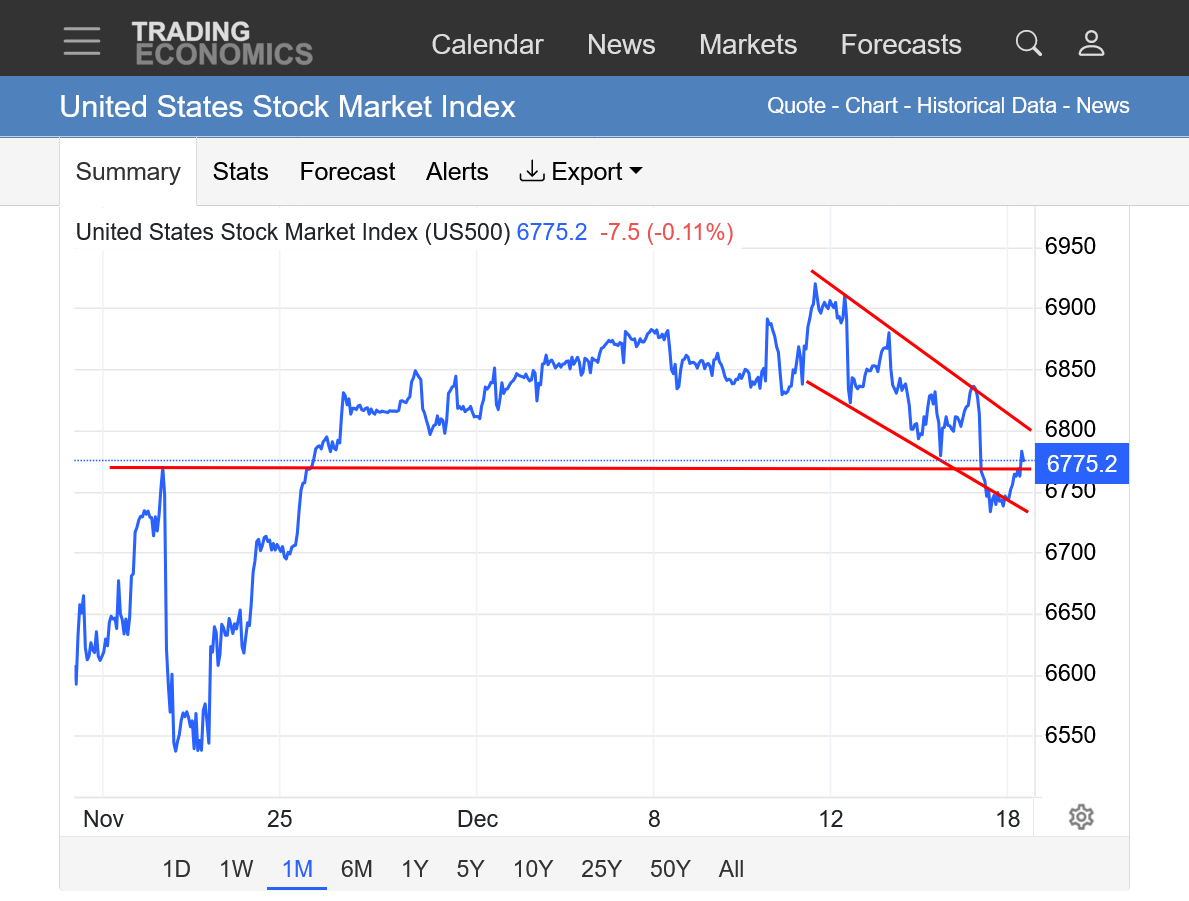
1. 1 week: Red line on the right was the release of the lower than expected, bullish inflation #. This is ammo to make the recent drop just another bull flag.
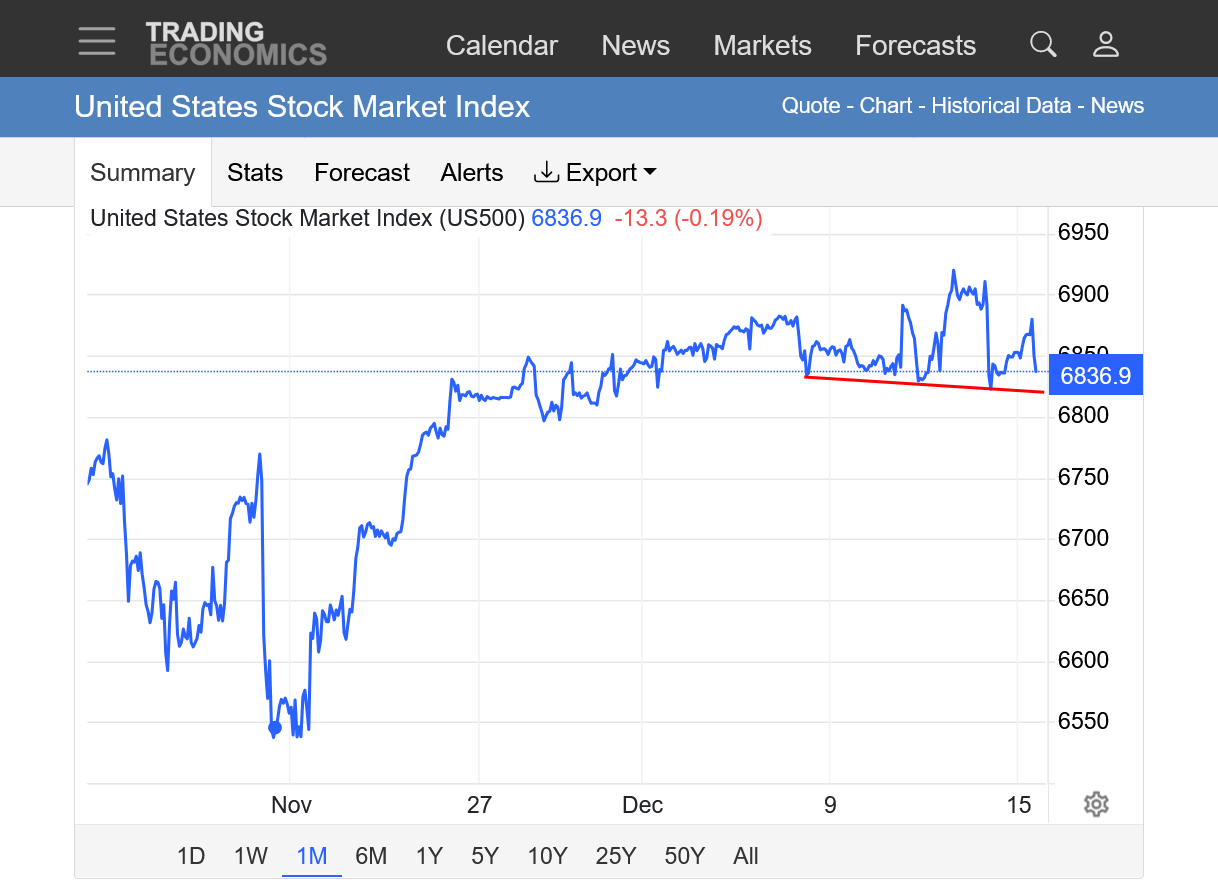
2. 1 month: After the top last week, clearly defined down channel that could be another bull flag. Potential support with horizontal line.
How the market reacts to this bullish news today is a huge deal!
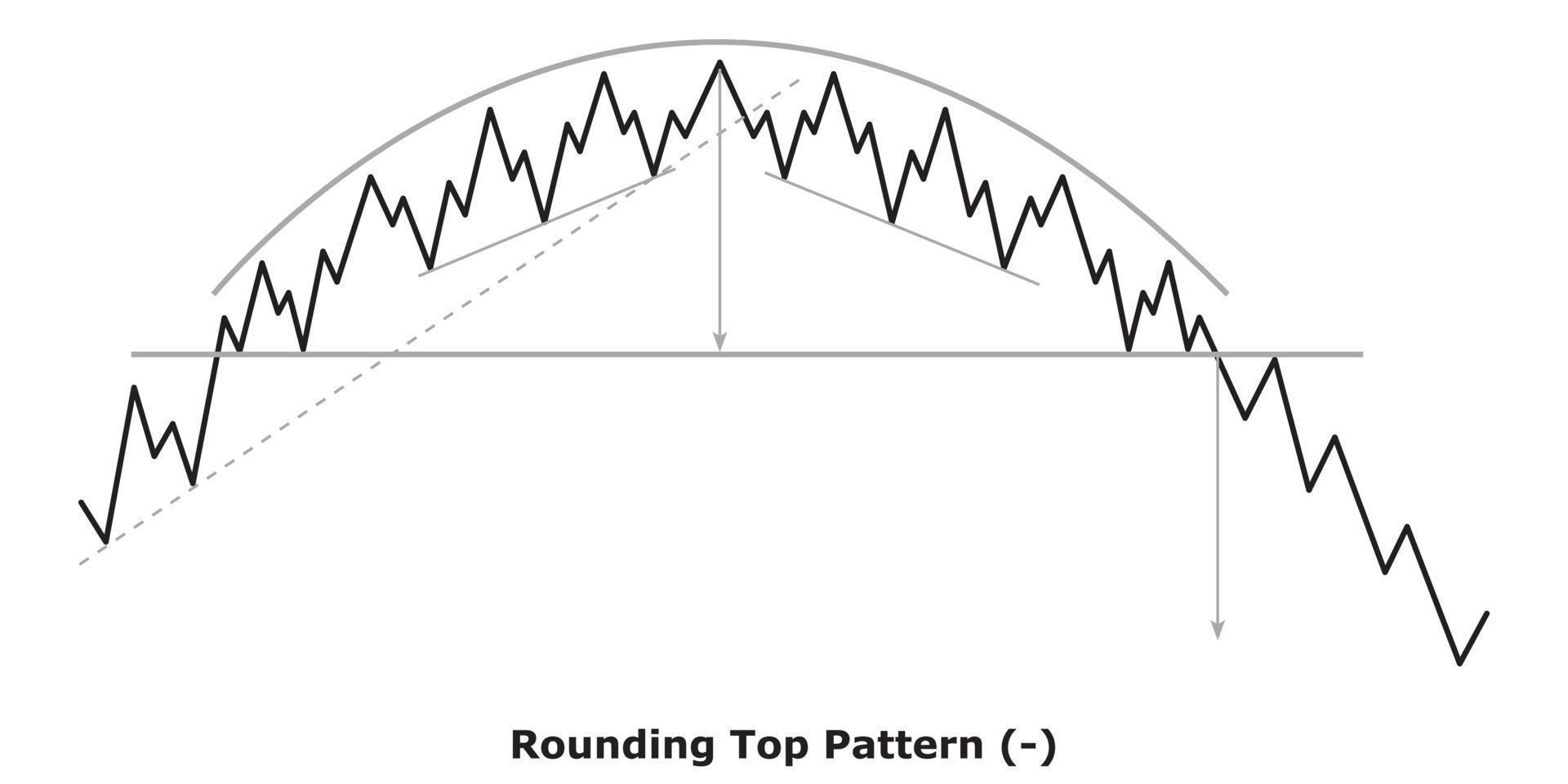
Rounding top formations in the stock market indices at several time frames. Losing momentum! I have never traded stock indices and this is NOT a prediction of THE top. Just a pattern recognition post based on the signatures right now. I can only draw straight lines on these price charts and not curved/oval lines/half circles to illustrate the rounding tops appropriately.
Basically, in a rounding top, the slope up the uptrend becomes flatter and flatter, with new highs being set by smaller and smaller increases above the previous new highs.