
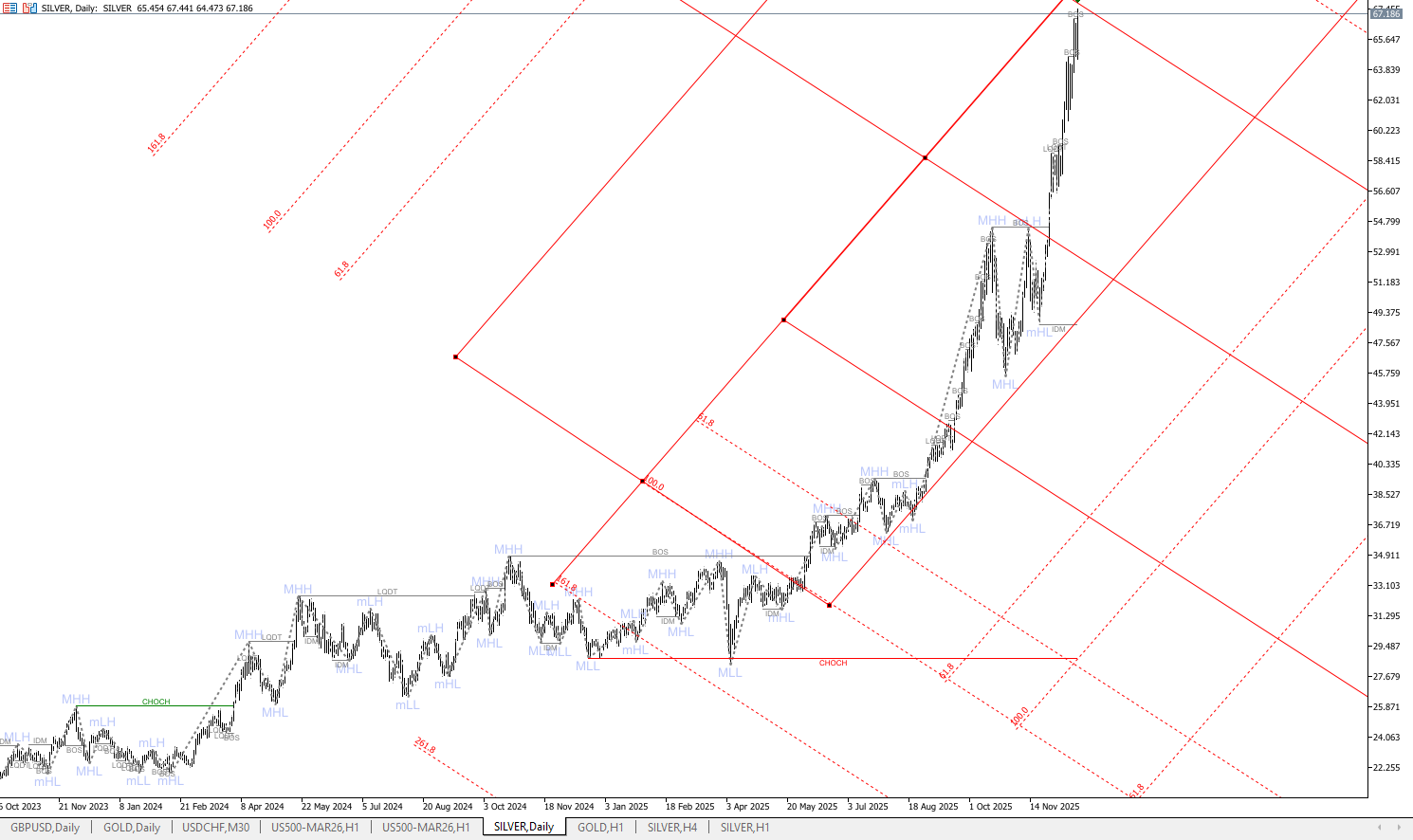
Projected ranges next 2–6 weeks:
| Date | Expected Range (GARCH Volatility Band) |
|---|---|
| 2 weeks | 62 – 71 |
| 1 month | 58 – 76 |
Based strictly on structure:
| Structure Level | Target |
|---|---|
| Next MHH extension | 72.30 |
| Fibonacci structure projection (1.618) | 78.40 |
| High-order MHH (macro) | 84.00–90.00 |
Astro signature
Pullback to minimal surface channel:
Target: 55 – 58 zone and 90 can be possible tgt in 2027 early ? all IMVVHO no trading recommendation--- 2cents !!
Thanks, fayq!
https://en.wikipedia.org/wiki/Autoregressive_model
+++++++++++++++
Now, back to planet earth (using other planets and astrology to predict things is fake science and has ZERO predictive skill!!!!!!)
silver
Started by cutworm - Dec. 19, 2025, 8:51 a.m.
https://www.marketforum.com/forum/topic/116644/
+++++++++++++++
Gold Update
29 responses |
Started by joj - Oct. 8, 2025, 10:42 a.m.
The Great Silver Squeeze of 2026: A Perfect Storm of Policy, Supply, and Industrial Demand
Global silver markets are entering what many analysts are calling the most severe supply crisis in modern history. Prices are not merely rising — they are exploding, driven by a fundamental shortage of physical metal.
While headlines attribute the surge to investor speculation, the underlying cause runs much deeper: a geopolitical and structural supply breakdown that is reshaping the world’s silver market from the ground up.
Below, we break down the five key forces driving this once-in-a-generation silver squeeze.
1. China Changes the Rules — and the Global Market Shifts Overnight
Starting January 1, 2026, China is implementing new export restrictions on refined silver that are already sending shockwaves through global markets. Under the new policy, only large, state-approved companies will be allowed to export silver, and only after obtaining special government licenses.
To qualify, firms must meet two stringent conditions:
These requirements effectively block hundreds of smaller and mid-sized exporters, who have long served as key suppliers to global industrial users and refineries.
China currently controls between 60% and 70% of the world’s refined silver supply. Therefore, even a partial restriction instantly creates a global supply shock. This move mirrors China’s earlier strategy with rare earth metals, where export controls were used to secure domestic industrial advantage and global pricing power.
In this case, silver’s role is far more strategic. It is not only an industrial input but also a monetary metal, essential to both high-tech manufacturing and global financial reserves. By tightening control, China is effectively weaponizing silver supply in the same way oil and rare earths have been used in the past.
2. A Market Already in Deficit — Now Entering Crisis
The silver market was already under immense stress before China’s announcement. For the past five consecutive years, global demand has exceeded total supply — creating a structural deficit that has quietly eroded inventories across the world.
In 2025, global silver demand reached an estimated 1.24 billion ounces, while total supply — including mine production and recycling — only amounted to about 1.01 billion ounces. This represents a deficit of over 230 million ounces, equivalent to the entire annual output of Mexico, the world’s largest silver producer.
Unlike gold, silver mining is largely a byproduct of other metal production — primarily copper, zinc, and lead. This means even if silver prices double, miners cannot easily increase supply, because their operations are driven by base-metal economics.
Adding to the problem, new mining projects take 8–12 years to develop, and ore grades are declining globally. Recycling contributes roughly 180 million ounces annually, but that figure has remained stagnant for years.
In short, there is no quick or scalable solution to silver’s structural deficit. The export curbs from China are turning a long-term shortage into an immediate global crisis.
3. Physical Inventories Are Collapsing Worldwide
The visible symptom of this crisis is the sharp depletion of global silver inventories. Both Western and Asian vaults have been drawing down metal at a historic pace.
At current consumption rates, some industrial regions have barely 30 to 45 days of accessible silver reserves.
This scarcity is driving a massive price divergence between paper-traded silver (futures) and the real physical metal.
In Shanghai, physical silver is now trading above $80 per ounce, while COMEX futures remain much lower, in the $30–$35 range.
This spread — the “physical premium” — signals that buyers are desperate for actual delivery rather than paper exposure. It’s not about speculation anymore; it’s about availability. The silver market is, in effect, bifurcating into two worlds: one where silver exists physically, and one where it only exists on paper.
4. Paper Silver Has Broken Away from Reality
For decades, the silver market has been dominated by paper contracts — futures, forwards, ETFs, and derivatives — that represent claims to silver rather than actual metal.
Today, this system has become dangerously over-leveraged.
The current paper-to-physical ratio stands near 356:1, meaning for every one ounce of physical silver, there are 356 ounces worth of paper claims circulating in global markets.
As long as investors and institutions are content to hold paper exposure, this system can function. But if even a small fraction of participants demand physical delivery, the market could face a catastrophic short squeeze — a scenario where there simply isn’t enough silver to meet contractual obligations.
This structural fragility is now being exposed. Market makers are stepping back, liquidity is thinning, and volatility is spiking as trust in the paper system erodes.
Silver prices are not just reacting to demand — they are reacting to the realization that the market’s underlying structure is no longer credible.
5. Industrial Demand: The Non-Negotiable Driver
Unlike gold, which is primarily an investment asset, silver’s industrial demand has become the dominant force in its market. Between 50% and 60% of annual silver consumption now comes from technology and manufacturing sectors.
Key industrial uses include:
The International Energy Agency (IEA) estimates that by 2030, the solar and EV sectors alone will consume half of global silver output, leaving minimal supply for jewelry, coins, and investment bars.
And unlike copper or aluminum, silver has no viable substitute. Its unique conductivity and reflectivity make it irreplaceable in high-performance technologies.
This means industrial demand is effectively inelastic — it does not decline even when prices surge. As supply tightens, factories will continue buying at any price to keep production lines running.
6. The Systemic Shift: What Comes Next
Institutional investors and major banks are quietly realigning their strategies in response to the unfolding crisis.
Many are converting paper ETF holdings into allocated physical positions, securing delivery before liquidity disappears. Others are building private inventory reserves, anticipating prolonged export restrictions and logistical bottlenecks.
This shift represents more than a temporary rally — it’s the early stage of a structural repricing of silver as both an industrial and monetary asset.
Once physical delivery becomes the benchmark for price discovery, the traditional futures exchanges like COMEX may lose control of global pricing altogether, similar to what happened in lithium and rare earth markets when physical shortages emerged.
Conclusion: The Era of Cheap Silver Is Over
Silver’s recent rally is not a speculative anomaly — it is the inevitable outcome of years of underinvestment, export control, and industrial overconsumption.
China’s policy shift has only accelerated a trend that was already in motion.
With inventories collapsing, deficits widening, and industrial demand rising relentlessly, silver is entering a new paradigm where physical scarcity defines value.
The financial system’s paper promises are being tested against the hard limits of geology, energy, and geopolitics — and the price action is revealing the truth.
In the months ahead, silver’s price trajectory will likely remain volatile, but one thing is clear: the world is waking up to a metal that has been underestimated for decades.
The Great Silver Squeeze of 2026 has begun — and it is rewriting the rules of the global commodity market.
IT’S OVER: Banks Tap Fed for $17 BILLION as Silver Shorts Begin to Implode
The headline wasn’t silver hitting $79/oz—the real shock came from deep inside the financial plumbing.
On the quiet Friday after Christmas, U.S. banks quietly tapped the New York Federal Reserve’s repo window for a massive $17 billion, a completely unexpected withdrawal of emergency liquidity. In normal conditions, year-end repo demand is modest. This size of drawdown—during a supposedly stable market—signals only one thing:
Severe margin stress and escalating liquidity pressure.
At the same time, the COMEX silver market showed unmistakable signs of strain:
This combination—Fed liquidity taps + record physical demand—is a classic signature of a market where:
Paper shorts are running out of metal… but the physical buyers never stop.
For decades, the silver market has been dominated by large banks and algorithmic players using massive paper short positions to suppress price volatility. That game works only so long as the system has:
All three of those pillars just cracked—publicly.
The emergency repo draw means one or more major players needed fast cash to meet collateral requirements. Rising silver prices force these same players to post more margin on their short positions. When the move is vertical—as silver was from $55 → $79—the collateral drain becomes violent.
Meanwhile, physical buyers are draining COMEX faster than shorts can cover.
This is how suppression schemes end: not with a bang, but with a liquidity run.
Deliverable inventories on COMEX are already historically thin compared to open interest. A few more delivery months like this, and the imbalance becomes impossible to hide.
A short squeeze in physical commodities doesn’t look like a single explosion—it looks like liquidity windows being tapped, repo markets spiking, and banks grabbing cash to stay solvent through margin cycles.
And that is exactly what we’re witnessing.
The message is simple:
**Silver isn’t just rising—
the system that held it down is breaking.
Thanks a billion, fayq!
Or maybe $17 billion in this case
There is much more going on than just huge demand exceeding supply in an historic way in the silver market right now.