Nasa has confirmed a 17000 pound meteor has hit NE Ohio around 9 Tuesday morning. Part of hit broke apart coming over Erie.
Thanks, mc. All I can say is “wow”!
Yes, thanks very much. That was huge!
I saw that on ABC nightly news tonight. It exploded in the air.
This is actually a very fascinating topic! Special thanks to you, mcfarm!
https://www.youtube.com/watch?v=dHBjApk3d6w
++++++++++++++++
https://www.youtube.com/watch?v=SE0P022jJMY
++++++++++++++++++++
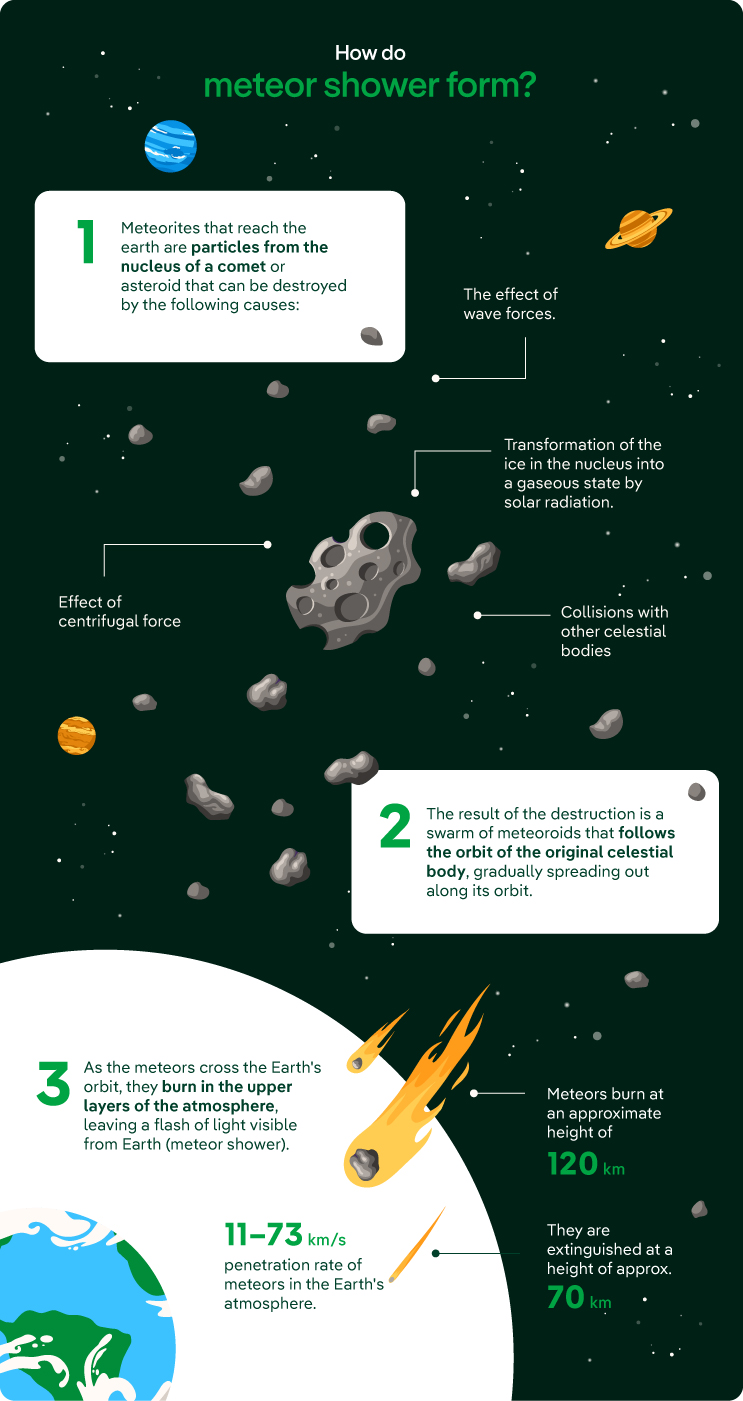
Meteorites on Earth: how many fall per year and why don't we see them?
https://www.iberdrola.com/about-us/our-innovation-model/meteorites-earth
https://www.nasa.gov/solar-system/asteroids/asteroid-fast-facts/
What Are The Differences Between An Asteroid, Comet, Meteoroid, Meteor and Meteorite?
Asteroid: A relatively small, inactive, rocky body orbiting the Sun.
Comet: A relatively small, at times active, object whose ices can vaporize in sunlight forming an atmosphere (coma) of dust and gas and, sometimes, a tail of dust and/or gas.
Meteoroid: A small particle from a comet or asteroid orbiting the Sun.
Meteor: The light phenomena which results when a meteoroid enters the Earth’s atmosphere and vaporizes; a shooting star.
Meteorite: A meteoroid that survives its passage through the Earth’s atmosphere and lands upon the Earth’s surface.
Size and Frequency
Every day, Earth is bombarded with more than 100 tons of dust and sand-sized particles.
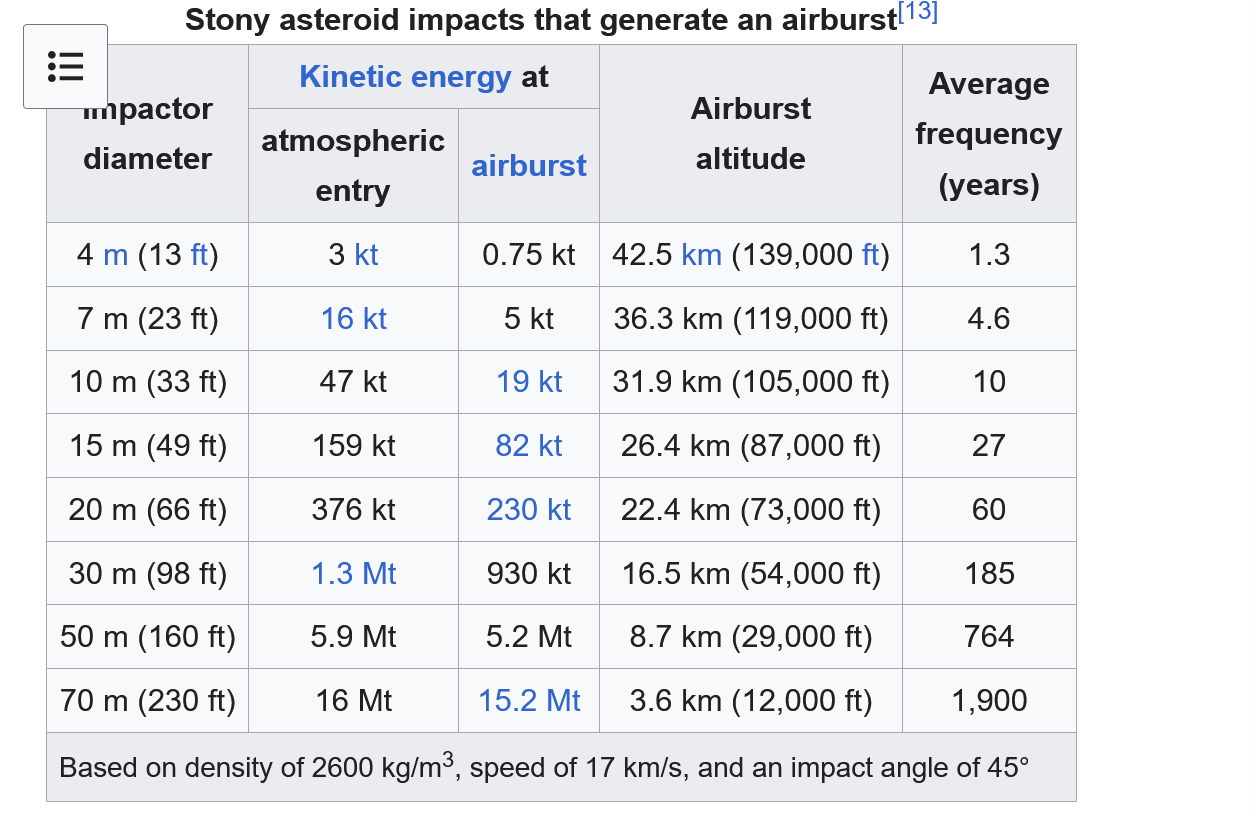
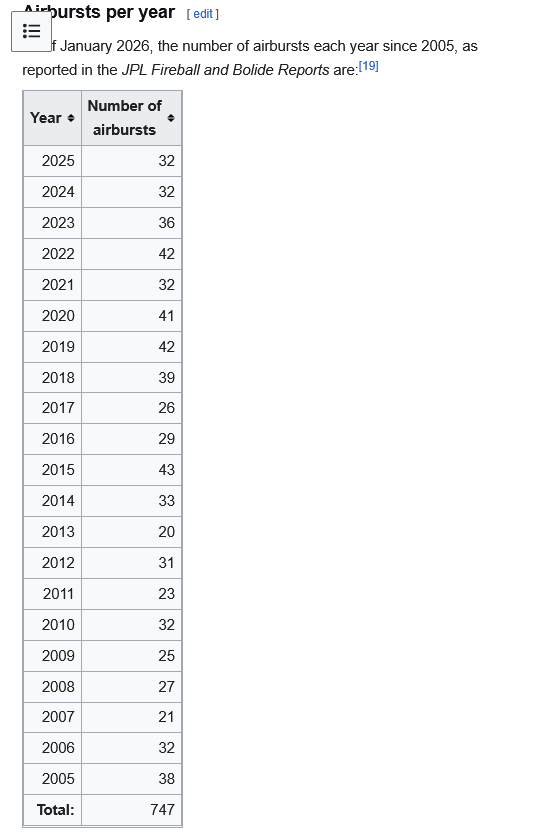
About once a year, an automobile-sized asteroid hits Earth’s atmosphere, creates an impressive fireball, and burns up before reaching the surface.
Every 2,000 years or so, a meteoroid the size of a football field hits Earth and causes significant damage to the area.
Only once every few million years, an object large enough to threaten Earth’s civilization comes along. Impact craters on Earth, the moon and other planetary bodies are evidence of these occurrences.
Space rocks smaller than about 25 meters (about 82 feet) will most likely burn up as they enter the Earth’s atmosphere and cause little or no damage.
If a rocky meteoroid larger than 25 meters but smaller than one kilometer ( a little more than 1/2 mile) were to hit Earth, it would likely cause local damage to the impact area.
We believe anything larger than one to two kilometers (one kilometer is a little more than one-half mile) could have worldwide effects. At 5.4 kilometers in diameter, the largest known potentially hazardous asteroid is Toutatis.
By comparison, asteroids that populate the main asteroid belt between Mars and Jupiter, and pose no threat to Earth, can be as big as 940 kilometers (about 583 miles) across.
https://en.wikipedia.org/wiki/Impact_event

Frequency of small asteroids roughly 1 to 20 meters in diameter impacting Earth's atmosphere.
https://en.wikipedia.org/wiki/Meteor_air_burst