
September 2nd, 2026 by Roy W. Spencer, Ph. D.
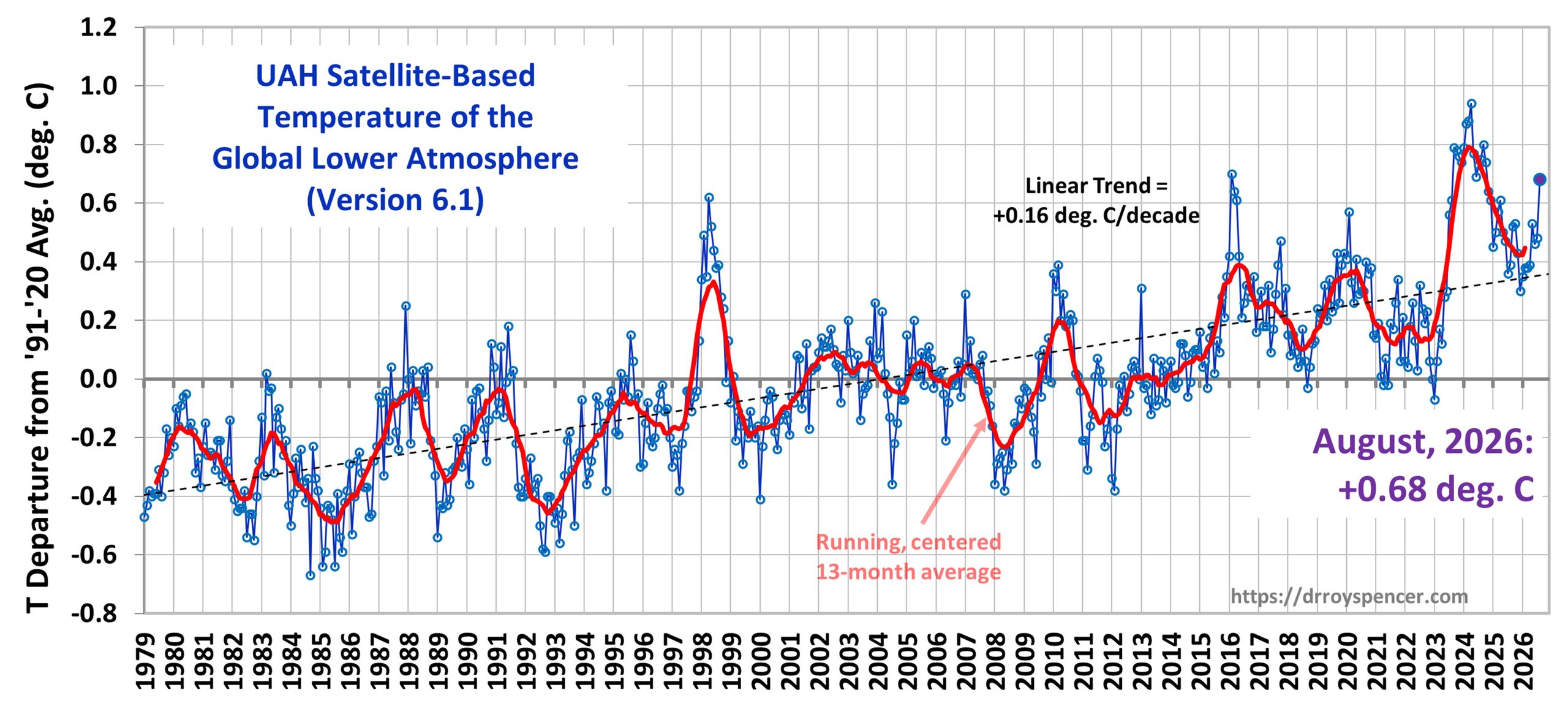
The Version 6.1 global average lower tropospheric temperature (LT) anomaly for August, 2026 was +0.68 deg. C departure from the 1991-2020 mean, up from the July, 2026 value of +0.48 deg. C. It appears the effects of the strengthening major El Nino event are beginning to appear in the global average tropospheric temperature, with an August temperature anomaly of +0.9 deg. C in the tropics. This month I’ve added a plot of tropical temperatures (below).
Previous thread:
UAH Global Temperatures for July 2026-hottest in US history
18 responses |
Started by metmike - Aug. 7, 2026, 12:30 a.m.
https://www.marketforum.com/forum/topic/122119/
++++++++++++
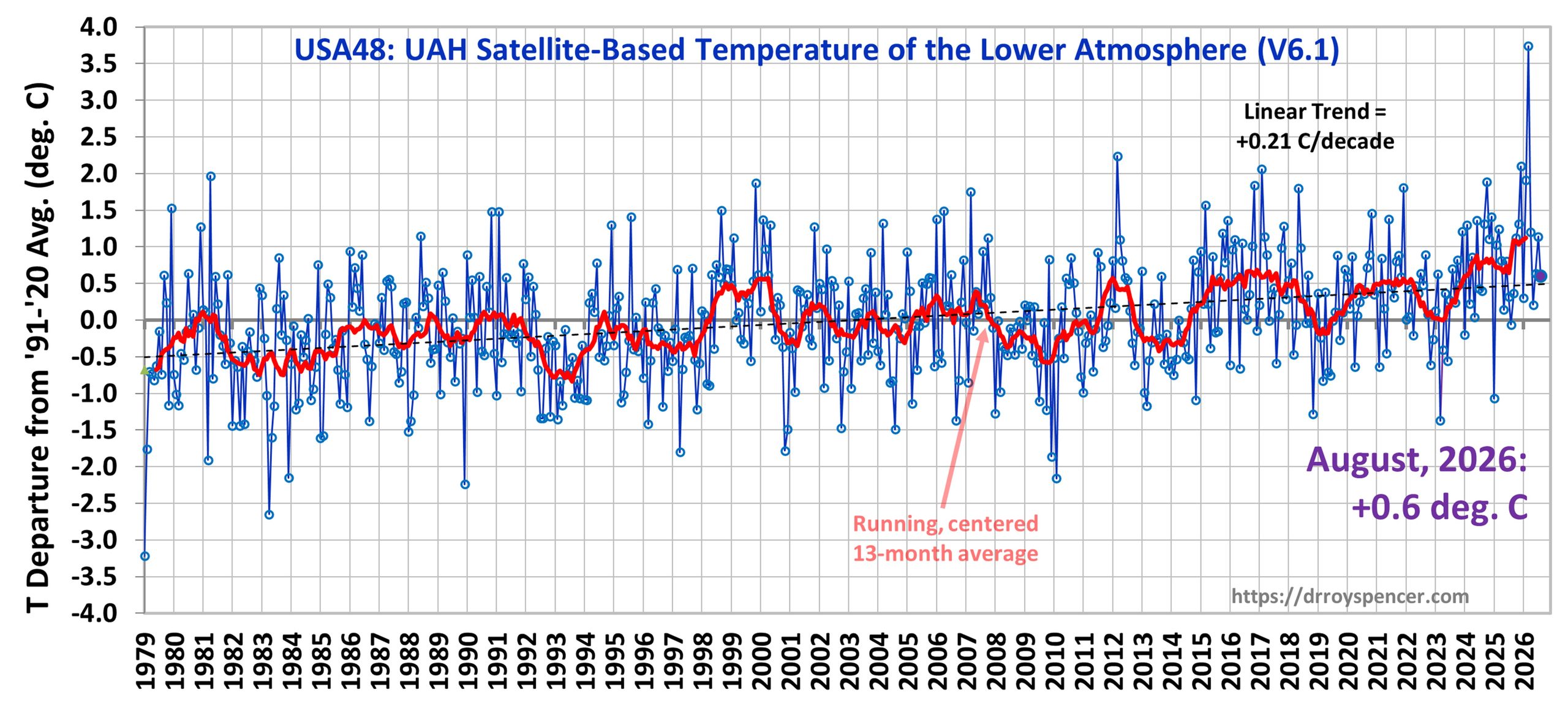
Dr. Spencer's updated graph for the US:
Note the reversion to the mean(uptrend line). What does this tell us about the record hot month, July 2026 which featured an extreme spike higher???
It tells us(proves) this:
https://cliffmass.blogspot.com/2016/03/the-golden-rule-of-climate-extremes.html
The GoldenRule
Considering the substantial confusion in the media about this critical issue, let me provide the GOLDENRULE OF CLIMATE EXTREMES. Here it is:
The more extreme a climate or weather record is, the greater the contribution of natural variability.
Or to put it a different way, the larger or more unusual an extreme, the higher proportion of the extreme is due to natural variability.
+++++++++++++
Global warming ADDED to the spike higher but most of it was WEATHER not climate change.
The NOAA Global report for August is out - https://www.ncei.noaa.gov/access/monitoring/monthly-report/global/202608
To nobody's surprise, August (+1.32C) & Jun-Aug (+1.21C) both set heat records.
I don't really get how they pick the local bits in the report. The fishkill in the Danube was rather sad.
Just wait another 6 months with this El Nino belching record heat into the atmosphere between now an then!!!
The previous temperature record will be left in the dust!
To understand this better, we should note that the oceans have 1,000 times more heat in them than the atmosphere with the Pacific ocean having half of that. 95% of the heat from global warming has been stored in the oceans and half of that is in the Pacific.
This El Nino region of the Pacific is 41 times larger than the state of Illinois and around 65% of the size of the United States. It's around 350 miles north and 350 miles south of the equator in the East/Central tropical Pacific, around 3,500 miles west to east.
The entire Pacific is 17 times larger than the United States.