
I'll be on, the awesome Catholic Radio Network/Relevant Radio and The Drew Mariani Show again today sometime after 2pm for something like 20 minutes to talk about the El Nino.
https://relevantradio.com/listen/our-shows/the-drew-mariani-show/
Drew Mariani is an award-winning journalist, writer and broadcaster. He currently hosts The Drew Mariani Show™ reaching a potential audience of 220 million people. His 3-hour daily program offers a unique insight on the most important issues of the day and a platform for dialogue with listeners and newsmakers.
This was our last El Nino thread:
2-17-26 El Nino, here we come-FAST!
51 responses |
I was going to call up & ask about Chemtrails but it was over before he asked anything interesting.
Yes, that went pretty fast patrick.
What actually happened is that they had a scheduled guest cancel at the last minute this morning and called me to see if I could fill 20 minutes talking about the Super El Nino.
https://relevantradio.com/listen/our-shows/the-drew-mariani-show/#podcasts
Go to the September 10, 2026 2pm show. First 20 minutes or so.
Great discussion with Drew M., Mike!
Thanks, Larry!
I love talking with Drew!
It started 20+ years ago when my brother in law, Mark Armstrong(a gifted radio man) was filling in for him while he was on vacation and had me on as a guest.
Since then, they've had me on at random times, especially during the hurricane season which has been non existent in 2026.
I've struggled in recent interviews because of what I thought was my brain's aging. Turns out that I discovered extreme sleep apnea, where my O2 was dropping below 80% from central sleep apnea numerous times on many nights.
I bought an overnight pulsox meter to monitor my wife's sleep apnea better(she uses a CPAP machine already) and decided to wear it myself 1 night. HOLY COW!!! I was shocked at the spikes down as low as 70% from not breathing for 2 minutes.
I immediately bought another pulsox meter. One with AN ALARM ON IT to wake me up, when my O2 dropped below 75% (my setting on the alarm because below 80% would wake me up too much and I just wanted it to stop me from dying), while I waited for a sleep study for 3 months in order to verify my condition and get a CPAP machine.
The alarm woke me up dozens of times when my O2 dropped to 74% with my brain not telling me to breath each time (Central Sleep Apnea). Another 2 minutes of that and a person dies in their sleep and everybody just thinks they had a heart attack.
In took 6 months but I finally got a CPAP machine in May of this year and the CPAP machine keeps my O2 readings mostly above 90% with only half a dozen spikes down to as low as 85% on a bad night.
Why am I telling this story???
Because my assumption that my loss of cognitive skills, including typing was from premature aging of the brain was actually from the SEVERE sleep apnea
As a result, the treatment with a CPAP machine has actually healed my brain a bit, with some recovery from the previous brain damage caused by years of O2 deprivation while I slept. Some of the brain damage is permanent, like with my typing skills not what they used to be late in the day and especially making tons of grammar mistakes here but I've noticed much less brain fog that seemed to impact me on many to most days.
I only made 1 mistake yesterday, mentioning Argentina as a place impacted by drought from Super El Nino when it's actually at risk for extreme rains (and realized that immediately afterward but nobody except me knew).
OK, 1 other one earlier when I was describing an El Nino and said that warm AIR is piling up from the west to east flow when I meant WATER.
And fortunately, Drew asked me great questions that I knew the answers to from following this El Nino so closely, thanks to posting about it on MarketForum. In the past, he loved to ask me a random science question at the end, like about the risk of a flip in the earth's magnetic poles which I can answer easily here, given XX minutes to do the research for a definitive explanation but would leave my damaged brain struggling to respond with clarity as an authority when forced to provide an immediate answer.
Anyways, the point of this is for everybody reading this post that has not been tested or is already using a CPAP machine to get an overnight pulsox meter to monitor their O2 overnight. They cost less than $100 and tell you the most important thing about your sleep. How long you slept and what your O2 was every second of that time.
And you can measure that every second for the rest of your life by just putting it on your finger every night and recharging the battery the next day. As a scientist, the favorite part of most days and when I load all the sleep data every morning and record it. I've been tracking numerous metrics that the pulsox meter records in a log, every single day since last November. It's why I can appreciate the difference from before and after the CPAP machine. It's amazing too, the difference between bad nights today (that are better than good nights before) and great nights now.
Thinking back now, I am guessing that I had this extreme sleep apnea condition for as long as 2+ decades and had no idea!!! No telling how many brain cells died from the thousands of extreme drops of my O2 during that time.
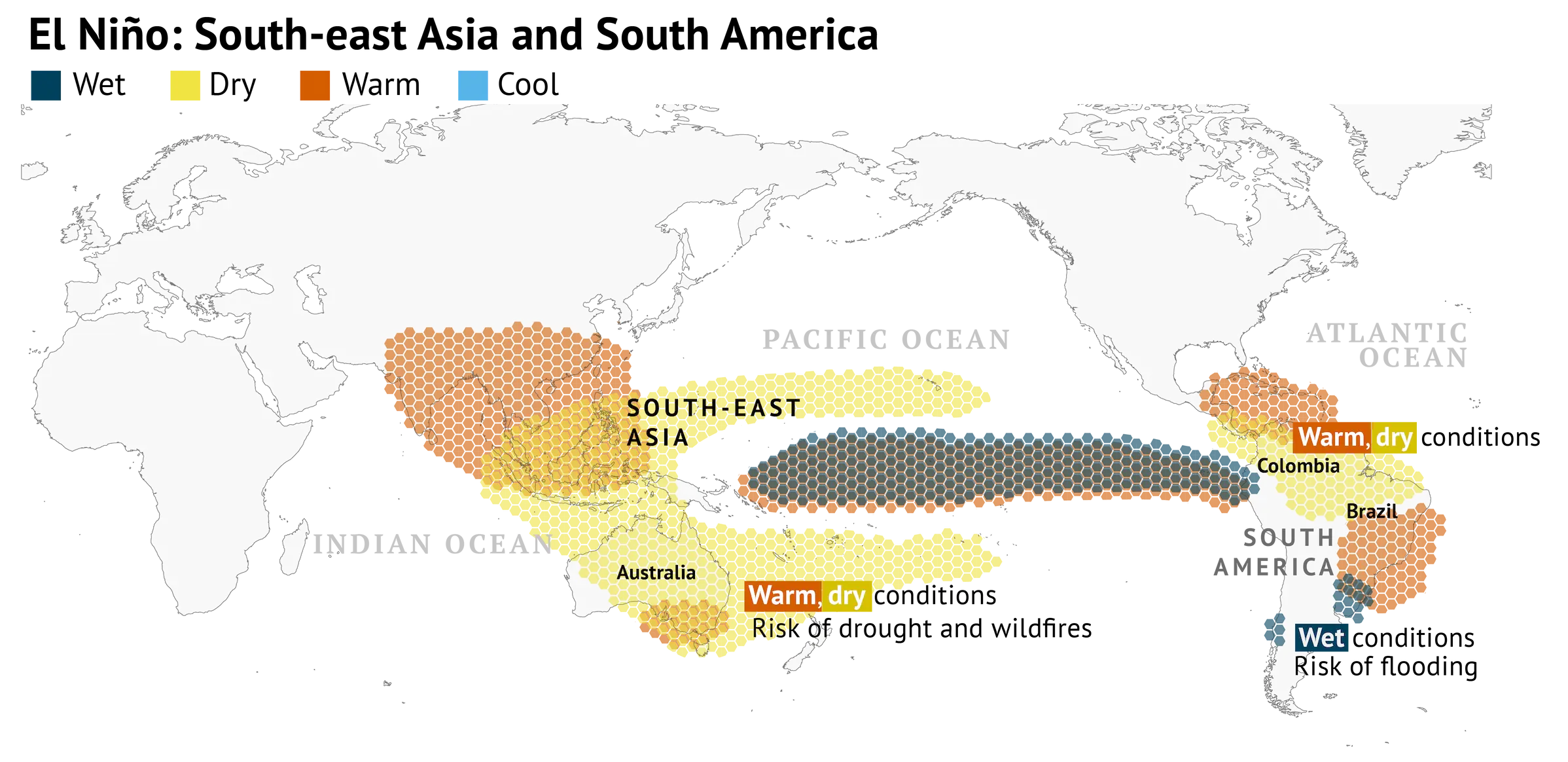
https://interactive.carbonbrief.org/el-nino-explainer/index.html
Oh, man, that hits close to home. As someone who is lucky to get 5 hours sleep in a night*, definitely going to get a pulsox meter next time I'm near a drug store.
Thanks!
* I've been in the REGARDS stroke study at UAB for 20 years. Last year they had me wear a monitor watch for a week and it said I was awake about half the night. Then they sent around a nurse to do an EKG, and it found Afib. But no strokes!
Ain't getting old fun?
Thanks, patrick!
If I didn't take a high dose of Doxepin every night 100 mg) I wouldn't be able to sleep well either. It also helps with my pain ( I have Ehlers Danlos).
I have an extremely active, racing brain that won't shut down at night without that. Maybe that's you too.
On the Pulsox meter. The local drugstore has the instantaneous ones that don't record the data. The ones you need are the overnight meters that not only record everything, they give you average O2, 3% and 4% fluctuation events and graphs of your O2 and pulse as well as several other metrics for the entire night.
I don't want to recommend that EMAY pulsox meter that I use because of issues related to the cord to load data and recharge.
I needed one with an alarm on it to wake me up when I stopped breathing for a couple of minutes (hasn't happened with the CPAP but if our power went out-I would need it that night).
I wouldn't get that one. However, I think this below is the one my wife got without an alarm. It's not as convenient as the ones above that just go on 1 finger like a regular pulsox meter but is very cheap and works:
With regards to your Afib. I HAD severe Afib too. There is a strong correlation between Afib and sleep apnea with there being theories of which came first, like the chicken or the egg. It seems clear that sleep apnea can cause Afib because of the tremendous burden to your heart when your O2 drops numerous times in your sleep but there's some theories that Afib and sleep apnea have a similar, common cause.
They couldn't figure out the cause of my Afib and put me on Tenormin. I have an enlarged heart from my over exercising when younger and Ehlers Danlos but its very strong because I do extremely intense work outs on a Jacob's ladder and strength training as well as intense steam sauna's(everybody should do steam saunas at home). It probably prevented me from having a heart attack when my O2 dropped into the 70s so many times.
Anyway, because of my disease, I get blood work around 3 times/year to test everything. This includes all the metrics to measure my thyroid hormones(I take T3 and T4 meds since several of my glands are not making hormones like they should).
In doing that, I can graph the changes over time to see anomalies or tendencies. Turns out, that I discovered a causation relationship between when my thyroid hormones would drop TSH would go up) and the severity of my Afib. So when my Afib acts up, I know that it's time to boost my thyroid meds and blood work always confirms it. 100% every time. I'm guessing they tested you about this, however, my cardiologist and endocrinologist had no clue until I copied the graphs of my thyroid metrics and correlated it to exactly when my Afib acted up.
You might check that and other hormones that can impact Afib. I can also do EKG's on my smart watch, although my Afib is extremely noticeable all the time when I have it.
If you're in a stroke study, maybe there is more monitoring of your conditions and blood work than the average person.
AI Overview
+++++++++++++++
There's dozens of things that I don't know about you but I do know one thing. Restorative sleep is extremely important to most people's health. My Dad could never sleep more than around 5 hours a night and lived to be 99, so everybody is different.
My wife has extreme insomnia and gets sick all the time(has a crummy immune system). I've been sick only a few times the past 30 years, with an overactive immune system and autoimmune disorder in addition to the Ehlers Danlos.
My mom had 2 strokes and 2 of her brothers died from strokes. Along with the Ehlers Danlos(that came from dad) I have an excessive bleeding disorder(lost enough blood 2 times to lose consciousness and the only reason I lived is because my blood pressure dropped so low, the bleeding stopped).
So my mom's DNA makes me vulnerable for strokes(blood clots) but my dad's DNA causes my blood to not clot well .
Here's another fascinating fact.
I've had high hemoglobin for 15 years. My endocrinologist wanted me to donate blood to get it down but I told him that I liked this condition. It's especially beneficial when exercising and he accepted that.
Turns out that my elevated hemoglobin was likely caused by my sleep apnea. Just like people living in high elevations, with less O2 develop high hemoglobin so that their bodies can capture more O2 from the air, my body was doing the same thing from my low O2 spikes at night.
Amazing!
I typed a long text, which took me better part of 1/2 hour and accidentally lost it. Frustrating.
I’ll start again:
A couple of weeks ago, I took a vacation in the CO Rockies. My hotel was at 8K ft. I hiked at elevations up to ~10.5K ft. (getting up there via gondola as opposed to climbing) and while it was easy to get out of breath, that’s normal that high and that didn’t stop me from hiking.
My problem was bedtime. I kept waking up out of breath seconds after falling asleep. So, I couldn't sleep and felt exhausted. My pulse ox had me at avg of 91 (range 86-96) vs my low elev. home avg of 97.
After a couple of nights like this: to prevent rest of my vacation from being ruined, I went to Urgent Care to see if they had med to help me. They first wanted to rule out something serious. Chest xray/EKG all normal. Bloodwork normal except for DDimer, which was 675 and then 740 on redo next day. These are slightly elevated vs normal of ~200-650 for my age. Elevated ddimer is caused by various things with pulm embolism the most worrisome. So, they had to do chest CT w/contrast. Fortunately it was normal. They prescribed me an oxy generator for night time with nasal cannula. On 2 liters, my ox rose to avg of ~96 and I slept great. So, rest of my vac was saved! For future mountain trips, I’ll order oxygen gen in advance.
However, ER doc recommends I follow up with my doc on ddimer and also ask to him about a possible sleep study to rule out sleep apnea. At home, I wake up only ~once/month or two out of breath from apparently stopping breathing. But then I go back to sleep and it usually doesn’t repeat. So, even if that’s sleep apnea, if it really is that infrequent, I’m guessing it’s not bad enough to worry about.
Mike, 2 Qs:
1. When you had low O2 episodes in your sleep, did you wake up out of breath? Or did you sleep through them? I’m glad you’re doing much better due to CPAP!
2. Do you recommend I buy an oximeter like you used before getting sleep study?
Sorry to hear that you lost the first post and had to type it over. The only good thing about that is that the 2nd time goes fast because you not only not what you want to say but also how to state it quickly.
Also sorry that you had the negative experience in CO. It certainly took away from the enjoyment. I'll bet the medical people there are extremely familiar with issues from the lower O2 at higher elevations.
My pulse ox had me at avg of 91 (range 86-96) vs my low elev. home avg of 97.
That's a very significant drop and some low readings. Here's what I think was going on with this sleep disruption.
Most people think that our brains (brain stem) tell us to breathe because it detects low O2 levels. Actually, it's when they detect HIGH CO2 levels. They usually go hand in hand. When your O2 drops, your CO2 goes up for the same reasons. But not always.
In your case, you were probably breathing excessively, maybe hyperventilating from the low oxygen which was causing you to exhale so much CO2 that it dropped TOO LOW. This signaled your brain stem to stop telling you to breath while you were sleeping.
I know this well because I have Central sleep apnea that featured my brain stem not telling me to breath. Not because of low CO2 but because of a pathological condition.
While waiting 6 months for my sleep study and CPAP machine(they refused to do anything to speed it up) I searched for methods to stop my O2 from dropping below 80% on most nights. I found some studies that had success by giving people with CENTRAL sleep apnea, CO2 to elevate the levels in their blood in order to cross the threshold that triggered their brain stems to tell them to breath.
So I turned it into an experiment at home. Getting a CO2 meter and sleeping in a small closet with the door shut that caused my breathing overnight to elevate the CO2 in the closet above 1,000 ppm(compared to the 430 average in the outside air and elevated levels inside but not as elevated as the small closet).
For several weeks this reduced my severe events by 50%(that I could measure accurately on the overnight pulsox meter).
Sounds crazy to increase the CO2 in order to increase O2 but this is what happened because my brain stem is damaged and needs more CO2 than most brain stems to tell me to breath.
The first time that my pulsox meter woke me because my O2 was at 74%, I thought it was broken because my brain wasn't telling me to breath. The next 20 times that happened, I realized that it was my brain stem was "broken". At 74%, the alarm would wake me up and the only thing I noticed was a pounding heart but the absence of a drive to breath. Not out of breath or gasping at 74%, just my brain telling me that everything is normal and I don't need to breath.
I tested this several times while awake by holding my breath for as long as possible. I failed to get down to 80%, even after holding my breath for almost 2 minutes because my brain stem was SCREAMING at me to breath with the most extreme discomfort imaginable. The same holding breath dynamic was happening at night, without the message from my brain stem.
With regards to getting an OVERNIGHT pulsox meter. This is even better than a sleep study in many ways.
1. It will tell definitively if you have sleep apnea(or some other condition like COPD) by measuring your O2.
2. If it shows your O2 stays elevated, your good, if not time to make the sleep study appointment.
3. Sleep studies are massively flawed!!! They capture a snap shot of 1 night under conditions that are much different than where you sleep. I can tell you from 200 nights of data gathering, that even with the CPAP machine I have great nights and not so great nights. Without it I could have near death drops in O2 or on other nights, while not in a deep sleep not have that at all. I know from experience with my sleep study that they want to completely define my entire condition based on what those 5 hours showed.............and ignore my data. When I copied the graphs of my severe drops to show the nurse practitioner and asked her what she thought, she said "those are artifacts from your device not working right" Then I told her I was wearing my wife's pulsox meter on the other hand to confirm the data and it recorded the exact same thing. She didn't say anything. Later on I pressed her to answer the question again and she said "That's some pretty bad sleep apnea"
4. The sleep clinic refuses to believe that I have Central sleep apnea because the sleep study didn't show it. I got into it with 1 lady for refusing to acknowledge my crystal clear description mentioned above and just repeating what everybody else says based on the sleep study data Gospel. This was BEFORE I got the CPAP machine(waiting 4 months after the sleep study).
5. The sleep study, because I was in a light sleep most of the night didn't even show much apnea. Luckily, I went into a deep sleep for 20 minutes and my O2 dropped to 70%. Outside of that, they would not have prescribed a CPAP machine for me and I would have been out of luck.
6. It took us numerous months to convince a pulmonologist that my wife has sleep apnea back in 2018. I would stay up and monitor the pulsox meter readings on her and she would drop just below 90% for much of the night but continue with shallow breathing. She literally got kicked out of being their patient because of me battling with them over her condition. I went to her appointments and the doctor even admitted that i was right all along when he finally ordered the sleep study and the results came back. Dr Rodriguez did not want a patient telling him what to do and holding him accountable and kicked her out because "her husband was harassing my nurses".
7. Around 20 years ago, for a few years, I would wake up gasping really bad for air from not breathing, maybe once a month but that went away. I do not snore and never have.
8. In recent years, I would sometimes (most of the time no) wake up after one of these extreme events and just feel odd/unwell and have a hard time going back to sleep but no signs of a breathing issue. Never did I have a clue. Most of the time, my body never woke me up. I must sleep on my back because of my condition, with severe osteoarthritis in my shoulders(and degenerative spine disease) will not allow allow anything else. I need my knees to be bent and elevated but am VERY comfortable, thank God! And get tons of sleep now, that includes late morning naps to make up for nights when I wake up after 4-6 hours, unable to go back to sleep.
9. Once you buy this device, you can record data for many nights to get a much more comprehensive understanding of the RANGE of your sleeping metrics that includes good and bad nights. You will have it forever! A sleep study will cost lots of money and only tells you about 1 discombobulated night.
10. When I was battling these people over my condition being Central sleep apnea, they scheduled an appointment with their super expert. He was explaining that my sleep apnea was not as bad as many people because I only had X number of events and my averages for the night were not that bad. I told him that Evansville IN has an AVERAGE temperature of 60 degrees but that is woefully deficient in telling us about the weather for 365 days. It doesn't tell us the number of 100 degrees days or those near 0. I told him that my average O2 can be 95% without that many total events but if during 1 of those events, I stop breathing and don't start breathing again, I died from untreated sleep apnea because my overnight averages weren't bad enough to justify treatment.
Jeebus.
That is all.
This is more information on how they treat CENTRAL sleep apnea with CO2, to raise the amount of CO2 in the person's blood high enough to be above the threshold needed for the brain stem to trigger breathing.
AI Overview
AI Overview
+++++++++++++++++
https://my.clevelandclinic.org/health/diseases/central-sleep-apnea
++++++++++
I should add that the VAST majority of people have OBSTRUCTIVE sleep apnea which is effectively treated with a CPAP machine much better than CENTRAL sleep apnea.
AI Overview
++++++++++++++
Obstructive sleep apnea Symptoms and causes
Dec. 04, 2025
https://www.mayoclinic.org/diseases-conditions/obstructive-sleep-apnea/symptoms-causes/syc-20352090
+++++++++++++++
It's extremely likely that people reading this have sleep apnea(probably obstructive) and have no idea!
If not for my wife being hospitalized in June 2018 with severe bronchitis (and me being with her and noticing the dips in her O2 measurements, which incredibly the people at the hospital denied-a nurse threatened to kick me out because she said that I was upsetting her patient-then the pulmonologist at the sleep clinic insisted she can't have sleep apnea because his exam showed no physical characteristics) we would have no idea today. She would have gone another 8 years without treatment because there is no indication other than her O2 dropping when she lays back. She has an anatomical anomaly with small lungs and a narrow airway that not 1 doctor has ever been able to appreciate.
I would still have no idea too if not for buying/testing my wife with the overnight pulsox meter to make sure her CPAP machine is doing what it's supposed to do(keep her O2 up) and decided to try it on me.
I do not snore and she rarely does. She just has extremely shallow breathing that doesn't stop or get completely blocked. There are numerous variations of sleep apnea that don't fit exactly with the classical cases and cause people with exceptions to never have any idea they have it.
I know of several people that very likely do have it because their wife or they tell me X,Y or Z that match up perfectly with it.......by they won't get tested. In fact, I'm going to copy the link to this thread to 1 of them and change the title.
NOT treating sleep apnea takes away from restorative sleep, can do brain damage and can wreck your body in numerous ways.
My dad had extremely severe sleep apnea(we could hear him snoring on the 1st floor from our 2nd floor bedrooms as kids). Mom saw a story about sleep apnea on tv in the 1980s that caused her to insist that he see a doctor. The last 4 decades of his life featured a CPAP machine, which was extremely likely part of why he lived to be 99 years old!
++++++++++++++++
I am having issues with the devices I bought.
The EMO 90 has a problem with the charging and data loading cord(which is resolved at the moment by having it half way plugged in). The EMO 80 only take batteries and it uses up 2 AA batteries every 3 nights and won't take rechargeable batteries. I needed those with an alarm to wake me up when I stopped breathing for 2 minutes from fairly rare CENTRAL sleep apnea. Most people don't have a pathological medical condition impacting their brain stem like me and don't need an alarm.
EMO 80
EMO-90
This is the one that I got my wife and used initially that is very reliable but is a bit of a pain hooking up on your wrist/finger to secure at night compared to the EMO products that just go on your finger like a regular pulsox meter. They can fall off at night, where as the one below stays secure.
These are all the cheapest ones out there, that did the job which is what we were looking for. There are numerous other ones that I can't comment on which might be great.
Regarding the impacts of the 1870s El Nino, that killed close to 50 million people, especially from starvation from crop failures that resulted from droughts.
The impact in 2026 will NOT be as extreme on crops because of the increase in beneficial CO2. Not only is this greatly contributing to atmospheric fertilizer with the increase from around 290 ppm to the current 430 ppm. +140 ppm, on average is increasing plant growth by around 28%(+1% growth for every +5 ppm) but higher CO2 levels give plants more drought tolerance(they lose less water).
Their stomata don't need to open as wide to get CO2 and this causes less loss of water from their roots thru transpiration.
Same weather as the 1870s will cause MUCH less damage and harm. We also have more areas in the world producing food.
Most important of all is that technology today protects us greatly from the most extreme damage of widespread crop failures:
1. Greatly improved genetics that feature crops that do much better in heat and especially drought than those of the past.
2. IRRIGATION!
3. Synthetic fertilizers!!!!
4. Better pest, disease and weed control!!
5. Smarter/better soil management!