
As often is the case here, topics on 1 thing can morph into an entirely different discussion.
So here is a thread dedicated to the topic that was birthed by that dynamic.
Relevant Radio 2pm/sleep disorders
12 responses |
Started by metmike - Sept. 10, 2026, 12:55 p.
This was the last post at the previous thread:
By metmike - Sept. 13, 2026, 9:17 a.m.
I should add that the VAST majority of people have OBSTRUCTIVE sleep apnea which is effectively treated with a CPAP machine much better than CENTRAL sleep apnea.
AI Overview
++++++++++++++
Obstructive sleep apnea Symptoms and causes
Dec. 04, 2025
https://www.mayoclinic.org/diseases-conditions/obstructive-sleep-apnea/symptoms-causes/syc-20352090
+++++++++++++++
It's extremely likely that people reading this have sleep apnea(probably obstructive) and have no idea!
If not for my wife being hospitalized in June 2018 with severe bronchitis (and me being with her and noticing the dips in her O2 measurements, which incredibly the people at the hospital denied-a nurse threatened to kick me out because she said that I was upsetting her patient-then the pulmonologist at the sleep clinic insisted she can't have sleep apnea because his exam showed no physical characteristics) we would have no idea today. She would have gone another 8 years without treatment because there is no indication other than her O2 dropping when she lays back. She has an anatomical anomaly with small lungs and a narrow airway that not 1 doctor has ever been able to appreciate.
I would still have no idea too if not for buying/testing my wife with the overnight pulsox meter to make sure her CPAP machine is doing what it's supposed to do(keep her O2 up) and decided to try it on me.
I do not snore and she rarely does. She just has extremely shallow breathing that doesn't stop or get completely blocked. There are numerous variations of sleep apnea that don't fit exactly with the classical cases and cause people with exceptions to never have any idea they have it.
I know of several people that very likely do have it because their wife or they tell me X,Y or Z that match up perfectly with it.......by they won't get tested. In fact, I'm going to copy the link to this thread to 1 of them and change the title.
NOT treating sleep apnea takes away from restorative sleep, can do brain damage and can wreck your body in numerous ways.
My dad had extremely severe sleep apnea(we could hear him snoring on the 1st floor from our 2nd floor bedrooms as kids). Mom saw a story about sleep apnea on tv in the 1980s that caused her to insist that he see a doctor. The last 4 decades of his life featured a CPAP machine, which was extremely likely part of why he lived to be 99 years old!
++++++++++++++++
I am having issues with the devices that I bought.
The EMO 90 has a problem with the charging and data loading cord(which is resolved at the moment by having it half way plugged in). The EMO 80 only takes batteries and it uses up 2 AA batteries every 3 nights and won't take rechargeable batteries. I needed those devices because they have an alarm to wake me up when I stopped breathing for 2 minutes from fairly rare CENTRAL sleep apnea. Most people don't have a pathological medical condition impacting their brain stem like me and don't need an alarm.
EMO 80
EMO-90
This is the one that I got my wife and used initially that is very reliable but is a bit of a pain hooking up on your wrist/finger to secure at night compared to the EMO products that just go on your finger like a regular pulsox meter. They can fall off at night, where as the one below stays secure.
These are all the cheapest ones out there, that did the job which is what we were looking for. There are numerous other ones that I can't comment on which might be great.
Mike,
Do you think I should order this now from Walmart online before my doc appt on Sep 17th? It says it would arrive on Sep 15 if I order now. That would give me 2 nights to wear it before I see doc. TIA
Larry,
That looks like an excellent choice.
ORDER IT NOW!!!!!
If you bring the data with you to the appointment, it will pay massive dividends on taking the correct path for you.
If it's shows big dips or frequent dips lower, they should be able to immediately justify and schedule a sleep study, maybe even giving you priority (my doctor didn't) because you've already verified the sleep apnea.
Sometimes they will first schedule an overnight pulsox study with THEIR device. You might wait X weeks to schedule it, then Y time to evaluate it, then Z time for the next appointment to discuss it and THEN schedule your sleep study.
If you do this yourself, you should be able to leap frog over all that and go right to the sleep study at this appointment. Even though I did that, it still took me a whopping 6 months before I got my CPAP machine!!!!
Let me know what the data shows here and I can help you interpret that but you are one of the most analytical people I know and you will quickly become an authority yourself.
I have found this field to be rife with incompetence and bad interpretations because of using "averages" and other methods which don't properly assess the condition when it doesn't fit inside the box like my wife, Deb and mine.
However, the vast majority of people that need it, get a CPAP machine........eventually.
As bad as mine was, based on my overnight pulsox meter readings in November, I still had to wait for the sleep study 2 months later, then another 4 months for the CPAP equipment. 6 months of dropping below 80% at nights is totally unacceptable and medical malpractice in my opinion!
My wife had to wait almost as long, with the first 3+ months trying to convince the pulmonologist that she really did have it. I stayed up at night to record her readings while she slept and recorded that with several pages of observations for her doctor but the sleep doctor got mad and told her "tell your husband to never send messages like this to a doctor again"
So I didn't..........I WENT IN PERSON to her next visit. He had decided that he was the all knowing doctor and a no nothing husband wasn't going to tell him how to interpret medicine.
However, I had no idea that we could get an overnight device like this in 2018. In the end, he agreed with me in person at a visit that I was completely right........then he kicked her out as a patient because "her husband was harrassing my nurses"
I assume that you will not get a doctor like this but you will be armed with the empirical data from your overnight pulsox meter.
Mike, I ordered it this afternoon. Expecting it by Tue. Thanks for your advice!
YW, Larry!
I look forward to reading about, analyzing and discussing the data in detail! Other readers here will learn too and hopefully make the same move! Hopefully, you don't have sleep apnea but just confirming that is worth many times the value of this devise. Detecting severe sleep apnea, like mine did has a value beyond any monetary value. Health, especially cognitive health and extending one's life with good health is PRICELESS!!!
++++++++++++++
Larry,
I just thought of another idea, knowing that you are sort of a private person(unlike me). If you would prefer to discuss this, just between you and me I would definitely understand.
Anything that we shared would be confidential and not go beyond that without your authorization.
I will shoot you an email so that this option is available.
Dr. Mike
++++++++++++
BTW, good for you in taking this step. I am 100% positive, especially knowing how analytical you are that you will love this device and the data it provides EVERY SINGLE NIGHT for the rest of your life about your sleep..
As a fellow analytical nut, the favorite part of my day is often when I load the data to see how I slept that night.
Seriously, it's like getting a free sleep study every night(other than a few cents to recharge the battery). I have some anomalies, even with using the CPAP machine that make it more interesting than usual.
However, after watching 6 months of readings that sometimes dropped below 80% and 2 dozen times, set the alarm off, dropping below 75%, the last 4 months of NEVER dropping below 80% has brought tremendous appreciation of the profound benefits of what a CPAP machine can do and I'm reminded of that every time I load the data.
Actually, I think I can go back and take some of that and share it here!!!
I
I was at Walmart today. Bought a box labelled "smart ring health tracker". Alarm on it, so I couldn't open. Managed, with some difficulty to get that taken off at the service desk. Brought it home. Sponge filling, with a hole in the middle.
Empty.
Going back tomorrow. Wish me luck!
dang, patrick! You got ripped off! Hope you can get your money back, especially since I don't believe that devise it going to give you this data.
I have a smart watch that gives me the stuff that your device shows but it doesn't provide O2 readings.
+++++++++++++++++++++++++++++
Look at the one that Larry bought and consider buying that one or the cheap one that I showed which my wife got without the alarm. I don't see the need for an alarm for the vast majority of people. After looking at my O2 on 3 nights below, you can see why I immediately ordered a new one with an alarm to potentially save my life every night until I got the CPAP machine. One of the biggest reasons that I didn't already die in my sleep and haven't wrecked my heart if the intense exercise my entire life. What I can still do now is supplemented with intense steam sauna's at home that elevate my heart rate to 120 bpm.
++++++++++++++
OK, it took all day and finally my son helped me to convert the files to images so that they could be loaded here.
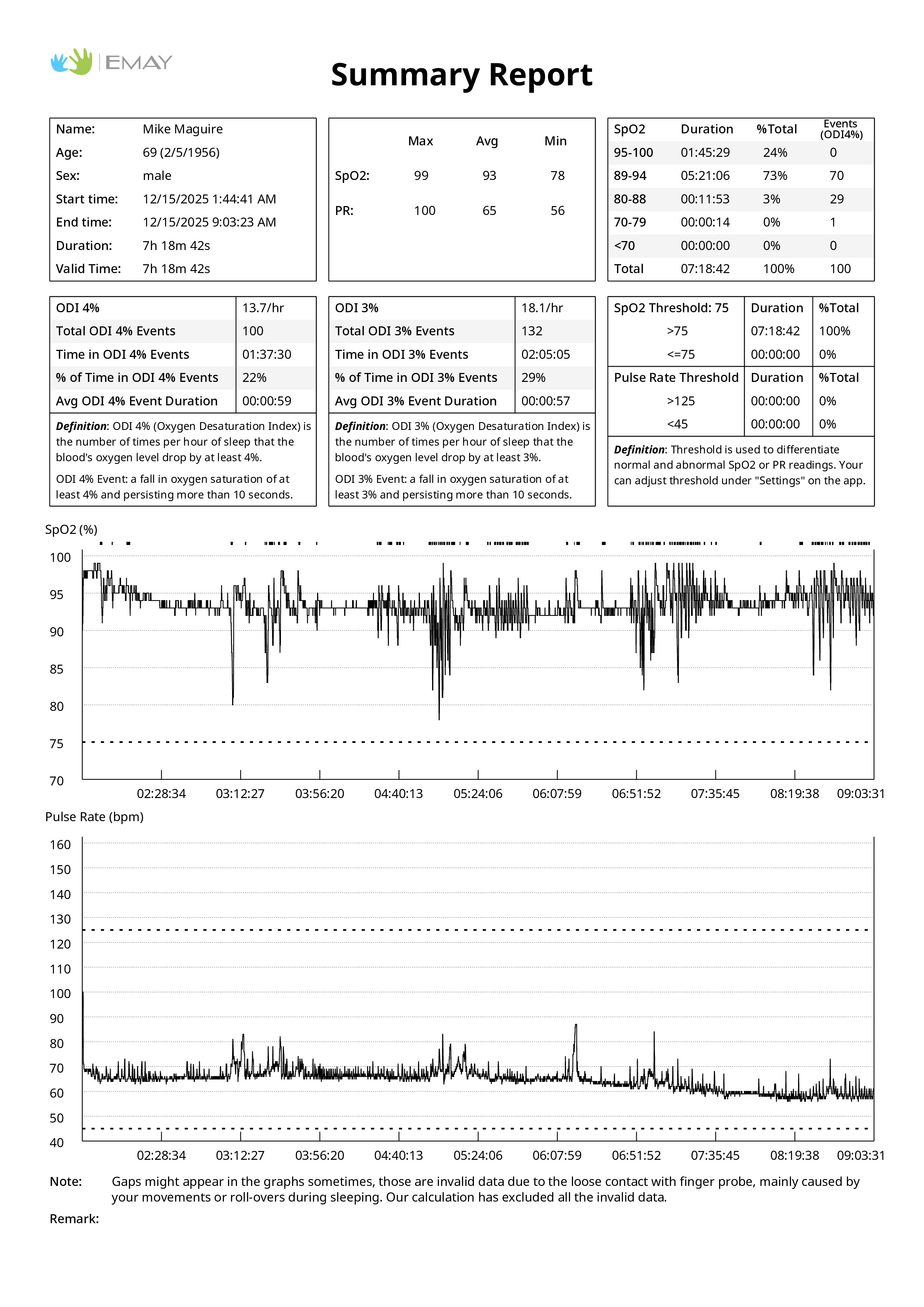
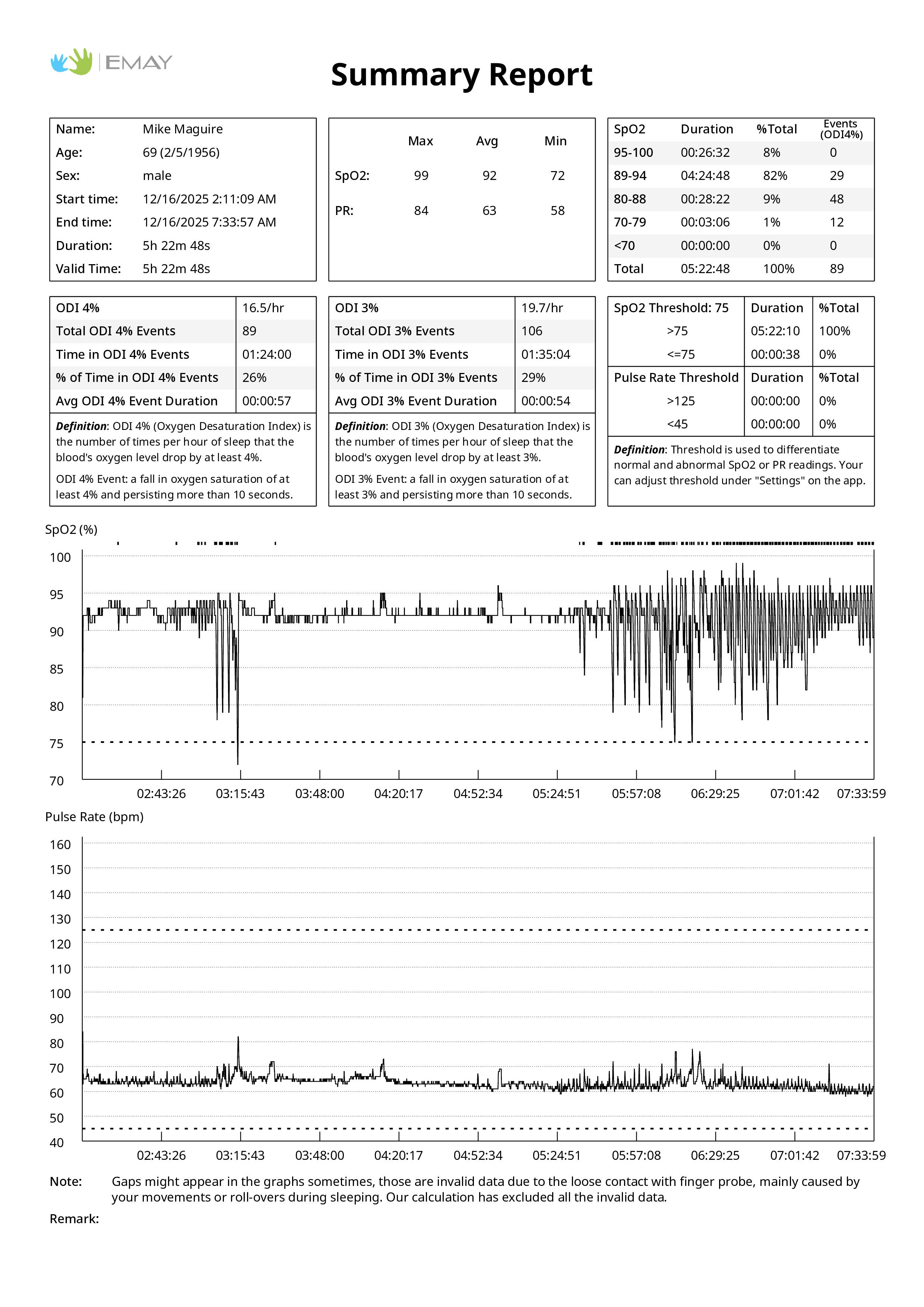
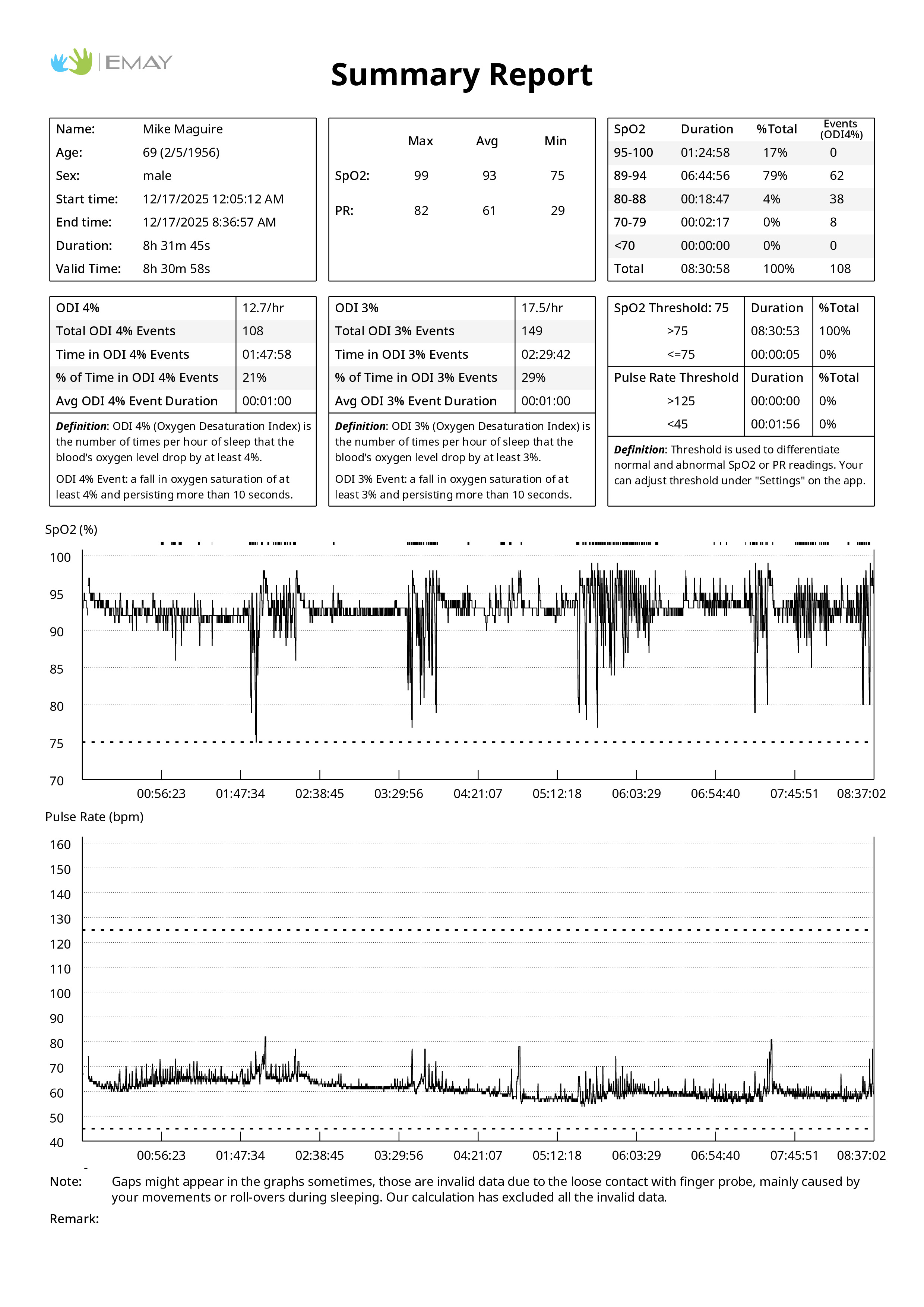
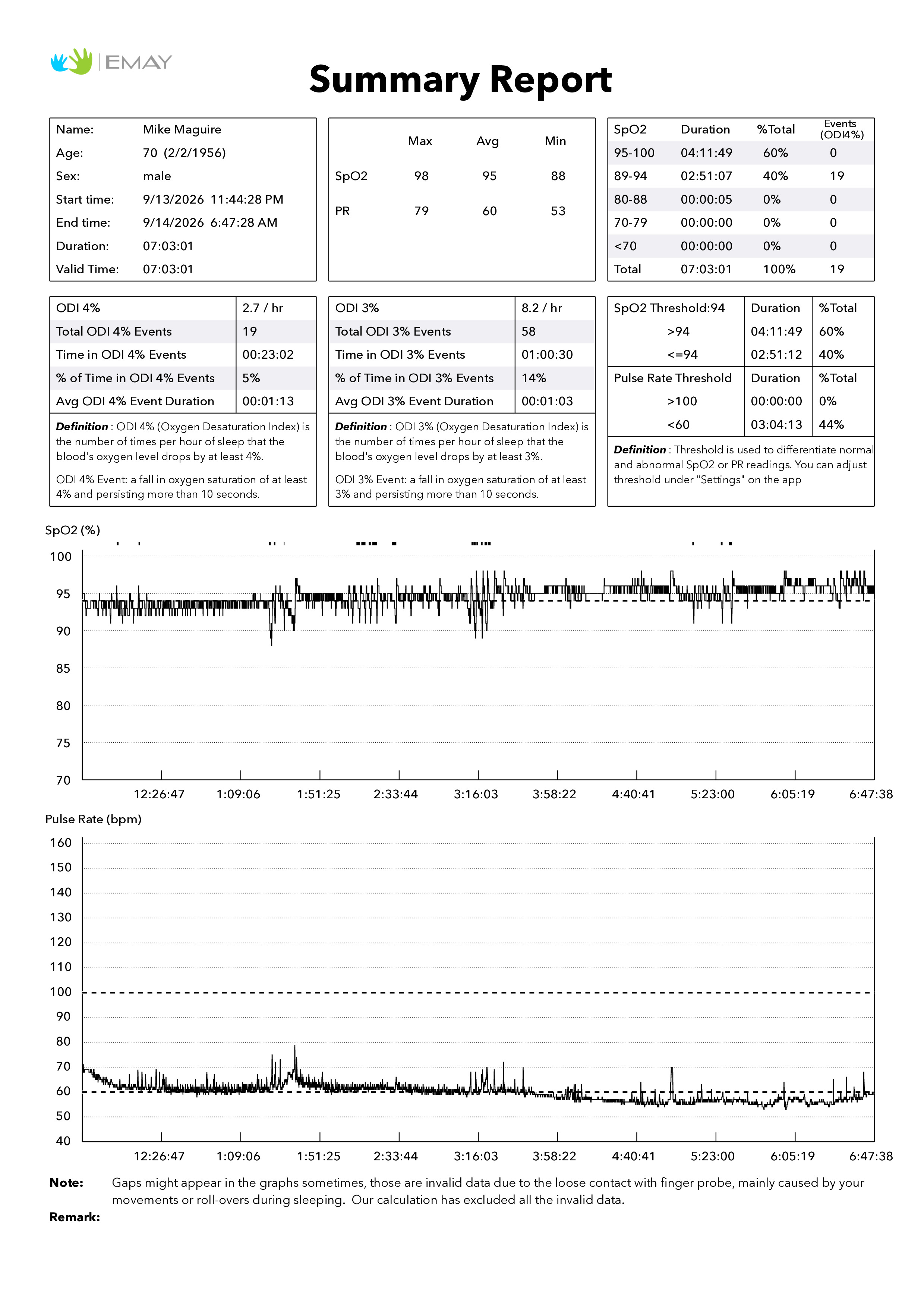
These are 4 nights of data in the last 9 months. The first 3 BEFORE the CPAP machine. December 15, 16 and 17. the 4th one was last night.
Note the top graph, which is the O2 in %. The bottom graph is pulse rate. Let's analyze just the O2!
1. December 15: Note all the drops in the 80s with a couple of drop to 80% and below. Average O2=93.
2. December 16: Insane number of extremely low drops! At first for a brief period just after 3, the 73% set my alarm off because it was BELOW 75%, then for 2 hours of the most insane readings you'll ever see towards the end of my sleeping while I was in REM sleep. 12 times to 80% or lower! I hit 75% 2 different times, just 1% above the level to set the alarm off. Average O2=92.
3. December 17: Looks like I hit 80% or lower 13 different times. Average O2=93.
4. September 13/14: Last night. The lows were 88X1, 89X3 and 90X4. Some people might consider this sub par but I am celebrating the massive improvement compared to before the CPAP machine. Average O2=95
As I mentioned in the previous thread, the average is extremely misleading. My average for the first 3 examples was at 92/93. It didn't tell us a thing about the EXTREME drops.
You can be at 95% for the vast, VAST majority of the night but if you are dropping to 80% or below, for even brief periods it's not only causing brain damage, you are getting close to DEATH. You have to stop breathing for 2+ minutes to drop below 80%. If you stop breathing for another 2 minutes because you have Central sleep apnea and your brain stem isn't telling you to breathe..........YOU DIE! So every drop below 80% on those graphs was half way to death!!!!
It's can take close to a minute of not breathing for your O2 to even start dropping below 90. When it hits 80% it's literally in a free fall lower.. It will quickly spike lower at a rate that will approach death in less than 2 minutes?
That's why I got an alarm on mine to wake me up when the O2 hit 74%.........and it woke me up 2 dozens times. 1 of those times, without the alarm could have been death.
However, I think that the threshold for CO2 increasing to trigger my brain stem(which is damaged from my Ehlers Danlos) to tell me to breathe is greatly elevated and all extremely low O2 times, my CO2 got so high that it finally triggered the breathing response.
patrick,
I looked at some of the Walmart's health/tracking rings. It looks like some of them might record this data. I'm unsure and can't recommend any of them, even if some might record the data that I showed on the previous page.
With some patience, Walmart gave me a refund.
So I copied Larry's order.
Made a big plan to take the wife & dog to the river, the UMass orchard, & Walmart.
But they're delivering it to our house on Thursday instead.
Prolly gonna stick to the rest of the plan.
Thanks, guys! Very enthused about the flood of data upcoming.
YW, patrick.
I look forward to continued discussions on this topic after you guys have data to share from your overnight pulsoximeters!
You picking apples at the orchard?
We shall see.
Should have gone there long ago.
https://www.umass.edu/agriculture-food-environment/cold-spring-orchard/farmstand
I received my Lookee Ring late this afternoon. I’m charging it now. I also downloaded the app, synced up with the device on my phone, and signed up.
So, I assume it will be ready to use once it’s charged up. I’ll probably try it out while awake later this evening followed by the big first sleep test tonight.
I tend to go to sleep very late. I guess that doesn’t matter. I’ll likely wake up at least once during the night. But hopefully it would still be one session. I expect to figure it out as I go along.
I hope I don’t have problems getting a good night’s sleep!
Larry,
Glad to read you got it so quick.
Once you set it on, it will stay on until you take it off or the battery goes dead. That includes being up part of the time. The battery should last for well over 1 night of sleep.
Looking forward to reading the results.
Thanks Mike!
So, once I put it on, how will my electronic diary know I’m sleeping or even in bed? I was thinking of putting it on when I walk on my treadmill shortly.
Am I supposed to separate awake activity monitoring from sleep monitoring into separate sessions? I’ll probably figure this out as I go along.
Will the ap hold onto all records permanently or will older records be written over with newer ones? How will I know whether or not any one really old record was during sleep? Maybe I should do this only during sleep so I’d know?
I guess based on pulse and maybe time/length of session I’ll know.
Ok, for my first session, I’m going to walk on treadmill.
This device is so cool! Thank you, Mike!
I found out I can label each session. So, that solves any confusion I might later have. :)
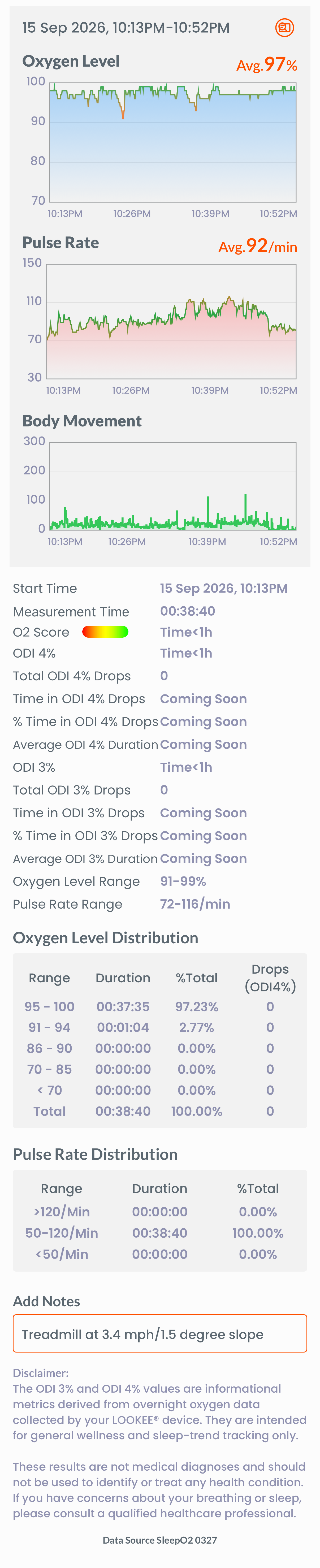
Here’s my 36 minute treadmill 3.4 mph/1.5 degree slope walk session:
I knew you would love it, Larry.
Looks like you picked a nice one and are a fast, self learner. Each device has differences and yours displays data a bit differently than mine but it’s all wonderful!
you ain’t seen nothin yet! Just wait until you have sleep data! The fun and learning has just begun!
The best thing with us sharing our experience/knowlege/data here is that readers can benefit enormously by doing exactly like we did!
Had I not bought mine late last year, I would still be wrecking my brain and health every single night because of episodes of severe sleep apnea!!! Or I could have died in my sleep considering the long periods with no breathing and extreme O2 drops.
My wife would have been sleeping with low O2 all night….for 8 years if we didn’t discover her sleep apnea from a fluke described in the previous thread. She has an anatomical anomaly with small lungs With none of the typical symptoms/traits.
8 years ago, I just put a regular pulsox meter on her and stayed up to watch it while she slept.
And good for you doing the exercise.
Hey Mike,
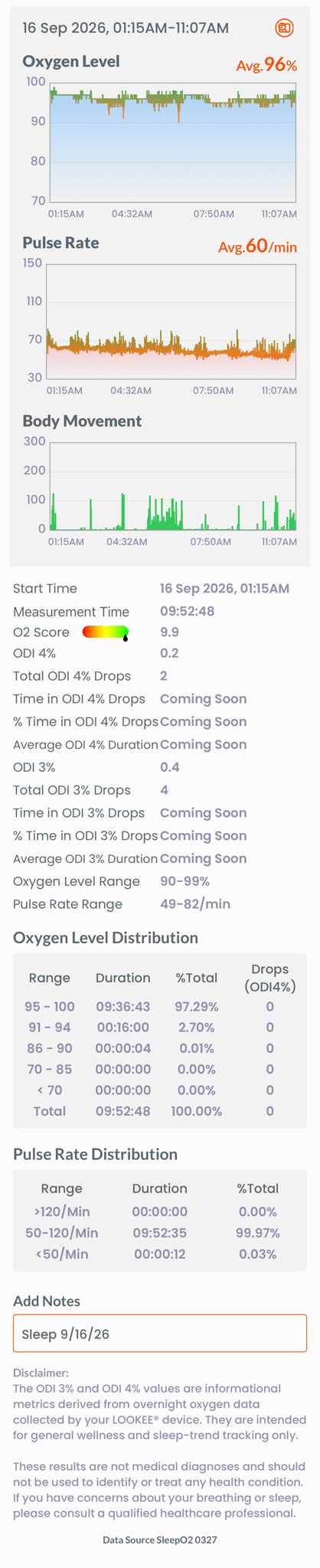
I wore the ring for last night’s sleep, which was high quality and left me feeling well rested. I woke up just after 5AM, browsed the net on my phone, went to restroom, and then put phone down and fell back asleep ~6:30. I was also up for a few minutes at the start and end. My total elapsed sleep was ~8 hours, which I’d say is higher than my avg.
Here’s my report (I’m planning on another session tonight so I’ll have 2 for my doc tomorrow). I see my O2 dropped to 91 once and 92 once early in my sleep, but the drops were very brief. I hit 90 briefly one time later though I may have been awake then. But are these even bad? My feeling is they aren’t.
My take on this is IF this is both accurate and actually representative of a typical night for me, I may not need to ask my doc for a sleep study. But I’ll see how tonight’s goes. Don’t these things vary from night to night for someone with apnea? And I know I wake up about once every month or two out of breath. So, perhaps I have a mild form of sleep apnea.
What are your thoughts about this report and also about how many nights are needed for a thorough analysis?
I find it interesting to see my avg. pulse very gradually drop through the sleep. Yours did the same per your reports. My low briefly hit 49, which was just before waking up for final time. In general when I’m very relaxed in bed, my pulse is often in the upper 40s to low 50s. Even for being in bed, that’s lower than that for the avg person:
I've been anxiously awaiting this data, Larry.
I'll have more comments later but these are the first impressions:
1. Your O2 readings are BETTER than mine WITH the CPAP machine. Good for you!
2. The brief dips are normal and nothing to be concerned about.
3. On the slowly falling pulse. Note the 4 nights that I sent featured the same thing. This is good-normal. That might seem a bit low but many healthy adults and athletes drop that low on a regular basis. If it starts dropping to 40 or less on a regular basis then it's something to be concerned with.
4. When we go into REM sleep, we often have brief spikes up in our pulse which often coincides with dips in O2. Looks like your minor drops in O2 were probably from this.
5. Continue to add numerous nights to this snap shot of your sleep for 1 night. There will be days when your activities, mindset or health are different; when you are under stress or having insomnia or in a deeper sleep or sick or exercised/late or when Donald Trump was impeached or whatever variable that can impact your sleep
This MIGHT impact some nights but judging from your solidly positive data, you have plenty of cushion for adversity.
6. If it was me, I would cancel the Dr's appointment if it's only out of concern about a pathological condition related to sleep but send them this data for their records if you want. If you have a family doctor, give them a copy at your next appointment for their records.
7. More comments later and please ask questions. I'll be out for several hours later this evening, meeting with potential investors in my wife's business. 1 of them is from India which is part of why I started this new thread:
Crisis from draining aquifers/underground water
Started by metmike - Sept. 16, 2026, 1:07 p.m.
https://www.marketforum.com/forum/topic/122814/
8. I am extremely happy to see this data come out great!
9. Man oh man this would have come in handy when you were in Colorado! That's a perfect example of how your sleep can vary from night to night. And you will learn things about your sleep, even if it's very consistent every night
10. I have a hard copy log where I record 10 different data values every morning going back to last November that includes notes on significant exercise/times and other factors. It's almost 20 pages long now! This was valuable to understand and monitor the severe sleep apnea before I got the CPAP machine. Even with the CPAP machine, I need to continue to do this. CPAP machines are not always effective in treating CENTRAL sleep apnea(that comes from a brain stem issue) but excellent for OBSTRUCTIVE sleep apnea that comes from a collapsed/narrowed airway.
In your case, logging everything will allow you to compare data from bad nights(if you have them) to see if there are any commonalities. If you weren't Larry the extremely analytical poster at MarketForum, I might not even suggest that.
Actually, everybody that comes here to discuss markets is very analytical but some of your posts remind me of many comments from my wife about how I can't help but analyze everything to death and drive her nuts.
You have the natural mind of somebody that makes an outstanding chess player. Note how I just can't stop analyzing in this post
Added:
11. I just remembered that you said that on rare occasions you wake up not breathing. Eventually it will happen when you are wearing this device and you will be able to see how that impacted your O2. Here's the thing. Many people with severe sleep apnea stop breathing many dozens of times each night or more and never know they did. I almost never woke up and was stunned to see how low my O2 was dropping. It's possible that your O2 is only dropping a bit below 90 when this happens, just like last night. For sure the more nights you record data, the more likely you will be to encounter rare anomalies, like the stopped breathing episodes. If, for some reason you are dropping to 75% or lower for instance, then you should have an alarm to wake you and need a CPAP machine.
However, the sleep doctor needs medical justification to prescribe a CPAP machine from a sleep study.
You can't buy one over the counter and a sleep doctor will not prescribe you a CPAP machine with home recorded overnight sleep data from a wonderful device like this, no matter how severe.
Insurance covers most of it.
+++++++++++++
AI Overview
No, you cannot legally buy a CPAP machine in the United States without a prescription from a licensed doctor. [1, 2]
Why You Need a Prescription
How to Get a Prescription Quickly
What You Can Buy Without a Prescription
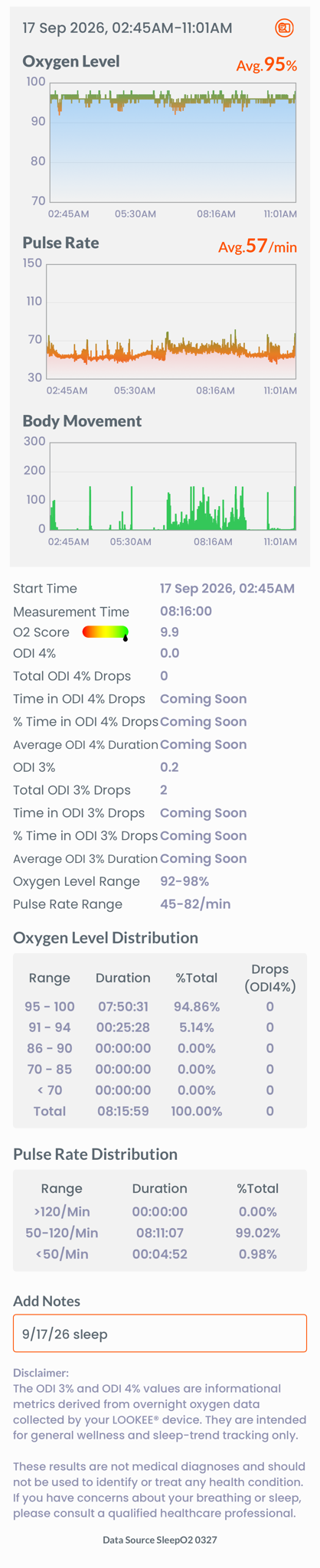
Here’s last night’s sleep report: I slept only ~5 hours total vs ~8 hours the prior night. Thus, I don’t feel as rested. I went to sleep much later and then woke up at 6:40 AM. I didn’t fall back asleep til ~9:20:
Thanks a ton for sharing with us, Larry.
We can see that in the data and here's more to add to that:
1. When you were awake, your pulse went up, before dropping again after finally falling back asleep.
2. Your average pulse rate was actually LOWER (57) than the night before(60). How can that be if you dropped lower during the first night??? Here's the reason. You used the treadmill on Tuesday Evening and your heart rate was still elevated from the late evening exercise the first several hours after going to bed!!!! This also made the slope of the drop down even more pronounced on your first night because you went from elevated to start with from the exercise late, down to your typical rock bottom low at the end(despite spikes up when we are in REM sleep). This ALWAYS happens to me on the evening's when I do intense exercise late and even steam sauna's.
3. I don't have the body movement metric on my meter(am forced to sleep on my back 100% of the night because of my physical issues-so it makes no difference). This measure shows your times being awake extremely well.
4. You can see the difference in your heart rate in the 2 nights. Unless I am wrong and you also did exercise last night too but your pulse suggests that you did not, at least not as late.
These are some of those things that, over time you will see reflected in your data when comparing tons of nights with each other.
When we have a sleep study, the odds of having an outlier night that is different than our TRUE average because of our bodies being discombobulated from the unusual environment is greatly elevated..............but that's the only one a sleep clinic will use to diagnose you and the only one they will use to treat you!!!!
You may find other correlations between your activities or food or health or mindset or sleeping effectiveness with time.
Last night was again, a great night that featured almost no sleep apnea's outside of a couple of isolated, normal ones.
Your O2 score was a 9.9 out of 10. As good as it get's with an average O2 level of 95%.
Your 3% ODI score (how many apnea events/hour that you had that caused your O2 to change by 3% or more was a rock bottom .2).
Even with my CPAP machine the past 4 months, I've yet to have a night as good as these last 2 nights of yours.
This is extremely good news! I will add again that something is going on when you stop breathing and wake up every month or 2. Eventually, you will capture that if you wear this device every night. The data will tell us how far your O2 dropped which will be correlated with how long you stopped breathing for and whether OR NOT you have some sort of extreme anomaly that only happens rarely.
Until we capture one of those nights in action with that data, we can't say definitively that there is nothing to ever worry about.
This is why sleep studies can be extremely misleading for people that don't have severe sleep apnea EVERY night. This is why this device is so valuable because it WILL capture every night, including those that feature an anomaly!!!
Thanks, Mike!
Indeed, I didn’t get a chance to exercise last evening.
Also, note that my lowest pulse was 45 last night vs 49 the night before. Should I be concerned about a pulse that dips that low even if only for short periods? Of course, the chart shows that it averaged at only 45-46 for only a minute or so at a time. However, it also shows avg stayed in only the upper 40s for one 15 minute long period and a couple other times for a several minute period.
With my older oximeter, I’ve measured my pulse in bed as low as 45ish a number of times when very relaxed by the way. But when it does I feel perfectly normal/no shortness of breath or pain.
Is it possible I’ll need a pacemaker down the road?
Glad to here that you did NOT exercise last night, Larry because that confirms the analysis philosophy.
Also, you stated that you did not get the chance to exercise, suggesting that you do it on a regular basis. This would also help to explain your low pulse rate. A strong athletic/healthy heart does not need to work as hard to do the same work pumping to circulate blood around your body as a weaker heart must do.
That low number sounds scary but it's very likely the opposite and an indicator of a very strong heart muscle from exercising.
+++++++
AI Overview
At the peak of his cycling career, Lance Armstrong had a reported resting heart rate of 32 to 34 beats per minute (bpm). [1]Elite Athlete Resting Heart Rates An average adult has a resting heart rate between 60 and 100 bpm. Elite endurance athletes often record much lower rates because years of heavy training make their heart muscle larger and much more efficient at pumping blood. [1, 2, 3]Other famous elite athletes show similar low resting heart rates:
You can read more about how endurance training impacts heart efficiency through the OpenLearn Athlete Heart Study. [1]If you'd like, I can help you:
++++++++++++++++
AI Overview
Your heart rate while sleeping typically drops by 20% to 30% lower than your daytime resting heart rate. [1]Normal Sleeping Heart Rate Ranges
How Sleep Stages Affect Heart Rate
Factors That Change Your Rate
+++++++++++
For our readers, this is a great example of how exercise benefits your heart with regards to its blood pumping ability. There are 100 other benefits! The only way to experience these wide ranging benefits is to MAKE YOURSELF DO THE EXERCISE!
Thinking about it or wanting to do it is a start but only counts AFTER you did it!!!! After doing it for XX times on a regular basis, it becomes part of a routine that causes you to feel better, be healthier and live longer.
Previous health related threads.
++++++++++
Managing stress
Started by metmike - June 16, 2025, 8 p.m.
https://www.marketforum.com/forum/topic/112588/
++++++++++
Instead of statins for high cholesterol!
Started by metmike - Dec. 19, 2023, 9:25 p.m.
https://www.marketforum.com/forum/topic/101376/
+++++++++++++
Exercise
Started by metmike - July 14, 2023, 4:15 p.m.
https://www.marketforum.com/forum/topic/97261/
+++++++++
Longevity
Started by metmike - Oct. 29, 2023, 2:19 p.m.
https://www.marketforum.com/forum/topic/100102/
++++++
I bumped into this thread about health, while looking and was reminded to be even more extremely grateful for my current physical health and mention that the knee is better than 80% recovered which allows me to still do the Jacobs ladder!
In the hospital
Started by metmike - April 22, 2025, 8:50 p.m.
https://www.marketforum.com/forum/topic/111436/
Hey Mike,
My doc looked at the 2 nights of Lookee data and said I don’t need a sleep study as we expected. Yay!
I forgot to ask him about my pulse getting to as low as 45 for short periods when in bed. But based on your analysis, I shouldn’t be worried.
Congrats, Dr. Larry!
Now you have a device to use that will measure every night for the rest of your life if you so desire. One of those nights will eventually capture a stopped breathing event.
There is probably a 99%+ chance that those events are nothing to worry about.
However, you could have a condition that needs X, Y or Z to happen before you cross the threshold into apnea-land!
This might have been what happened in Colorado when you were at a higher altitude with thinner air(lower pressure) and less O2 available for your body.
We speculated that this low O2 may have triggered a more rapid breathing/hyperventilating that resulted in your CO2 dropping below the threshold needed for your brain stem to send out a signal to breath(our brain stem tells us to breath when CO2 builds up and not from O2 falling, like most people think).
So this could be an indicator of an underlying condition in its earliest stage, when most people would have no idea but you are to be commended for taking your medical situation into your own hands.
You have a device that gives you a sleep study every night, instead of a 1 night sleep study that could miss an early stage condition and in fact, often gives misleading results for many people that have unusual forms of sleep disorders that might not happen during their 1 night sleep study, when their bodies are discombobulated compared to their usual sleeping.
++++++++++++++++
AI Overview
Yes, people without diagnosed sleep apnea can still experience brief pauses in breathing or irregular breathing patterns during the night. [1]Causes of Stopped Breathing Without Sleep Apnea
++++++++++++++++
Larry,
If you didn't have the issues in Colorado, I would say there's ZERO to worry about. However, you did, when that doesn't to most people based on the explanation above. Also the stopped breathing incidents you experience every XX days are real too and could be related or not. Regardless, it's impossible for your doctor to know exactly what the cause(s) were/are, even with 1 sleep study if they don't show up that night.
Since you have the overnight pulsox meter, I feel confident that it will capture some stopped breathing events. Then, you will likely know much more from the data that night.
I would keep wearing the device until it catches those anomalous nights when you wake up not breathing.
We are all aging, with new conditions slowly developing/emerging for some people. Your sleep data indicates that you aren't even close to having sleep apnea but if you are in the earliest stages of it or some sort of disorder, you will know way before most people do and be able to treat it before it does any harm.
AI Overview
Yes, central sleep apnea (CSA) becomes more common as people get older, with the risk increasing significantly after age 60 or 65. [1, 2]Why Age Increases Risk
+++++++++++++++++
I'm thrilled to have discovered my sleep apnea by a fluke(using a device I got to monitor my wife). Better late than never! However, I feel now that this condition has existed for a very long time (maybe 2+ decades?) and did some brain damage.
I say that to compel others here to buy this device like Larry did to confirm they DON'T have a sleeping disorder and to detect any issues as early as possible.
Absolutely buy one if you snore! Or if you wake up sometimes gasping for air.
++++++++++++
AI Overview
Common symptoms of sleep apnea include loud snoring, waking up gasping or choking, and severe daytime sleepiness. [1]
You can read a detailed overview of the condition and its warning signs on the Mayo Clinic.
Symptoms During Sleep
Thanks, Mike!
I had it on my finger last night, but for some unknown reason the data wasn’t recorded despite having an overall good night’s sleep. I feel fortunate that I got the prior 2 nights recorded for my doc.
Thanks, Larry.
I'm not familiar with your device but that has happened a couple of times to me when one of the settings was off instead of on and I didn't check it that night.
However, the device could be defective. Hopefully not.
Mine came yesterday. I've tried it a few short times. O2 is fine, pulse jumps all over (AFIB).
There is some trickiness in the shutdown. After a session raking leaves, it didn't want to download. The data was there, and after a second short session it properly downloaded both as separate files.
Going to go for it tonight.
I'm actually more interested in your data, patrick!
Do you take anything for your AFib?
I don't know a great deal about your medical condition but I'm sure you're already aware of the negative impacts in different realms for people with AFib.
Maybe we can make that better?
My dad had it and lived to be 99 years old but the rest of his health was incredibly good.
Metoprolol (beta blocker) & Eliquis (blood thinner)
I've never had symptoms.
Had a cardioversion, but it reverted after a couple weeks.
NFW I'm going to have heart surgery when I feel fine.
Thanks for that information, patrick!
Not to pry but I assume that you've had comprehensive blood work several times to make sure there's nothing out of whack. Hormones, electrolytes.......etc.
Is there a structural defect, heart disease, overweight, diabetes???
My AFib acts up mainly when my thyroid levels drop below a certain level (and my TSH goes above a certain level).
I have a sluggish pituitary gland(boss gland). An adrenal gland completely shut down Addison disease) but I supplement with synthetic hormones(thyroid/prednisone/testosterone) which keeps me going strong.
Your condition And AFib is likely much different but you would be surprised at how inside the box doctors make assumptions and base treatments on their training and experiences can limit their insight into an anomalous, outlier pathological condition.
The field that seems to be the opposite of that is endocrinology. The 2 that I’ve had were(1 still in practice)the best Doctors. I have an appointment with him in 3 days for my 6 month comprehensive blood work,
This doesn’t apply to world renowned medical centers like Mayo Clinic. Just most local doctors who are like baseball players that didn’t have to compete to make the major leagues.
Graduating from medical school is hard work and requires being book-smart and tons of studying.
But there is a wide range in their innate analytical and investigative minds. Some were blessed others not so much and it matters when applying the same principles of medicine to a challenging condition.
A great example for me is my discovery of using therapeutic doses of hyaluronic acid because all the synovial fluid in my joints was extremely low. This was a miracle benefit.
i told both my orthopedic surgeons and rheumatologist, especially for them to help their other patients but their response suggests they don’t do that.
I found a unique treatment for flat warts that my dermolotologist used to cure the flat warts of a patient with them for a decade. Funny thing is that mine won’t go away completely but his other patient is cured.
+++++++++++
As traders, think of it this way: Why do most people lose money trading, even really smart people, while others can make a great living doing the same thing??
Which type of trader would you want figuring out the best trades for you?
Which type of doctor would you want figuring out the best treatments for you?
Doctoring requires a medical degree of course, so the analogy is flawed in that respect but getting a medical degree does not make for the best doctors, only the basic training to be one.
You can teach somebody how to play baseball, for instance. They can play for years and understand every rule. They can BE UMPIRES that understand rules better than everybody. But only competition weeds out the best which rise to the top and play MLB.
This is not a comment about your doctors, patrick or Larry or anybody else here. They are probably great. You are the best judge for that.
However, it is a fact that explains why there are so many really bad doctors practicing and lots of mediocre ones(as well as gifted doctors).
I could write a couple of books telling the different stories about my experiences and those of family members, whose medical treatments I became closely involved in that featured blatant incompetence by the doctors.
Again, there are some wonderful, gifted doctors out there that would be in MLB if this were baseball. Also some that know how to play baseball but would have a hard time making the cut for their high school team.
And they ARE BOTH DOING THE SAME JOBS!
+++++++++
Bad doctors are often allowed to practice for decades.
AI Overview
Systemic gaps, institutional incentives, and professional cultures can sometimes result in substandard or dangerous physicians continuing to practice without facing immediate consequences. Investigative reports and medical studies frequently highlight several key factors that contribute to this phenomenon:1. Inherent Conflicts in State Medical BoardsState medical boards are the primary bodies responsible for licensing and disciplining physicians. [1, 2]
2. The Professional "Conspiracy of Silence"A long-standing cultural norm within medicine discourages physicians from criticizing or reporting the mistakes of their peers. [1, 2]
3. Masked Data and Confidential SettlementsThe mechanisms meant to track bad doctors often shield them from public scrutiny.
4. Hospital Financial and Legal ProtectionsHospitals have a vested interest in managing their public reputation and financial liability. [1, 2]
++++++++++++++++++++
The main reason to bring this up under this topic is that I have yet to find a good pulmonologist/sleep doctor, going back to when I discovered my wife's sleep apnea in June 2018.
Maybe it's just random bad luck. I have found great doctor's (and bad ones in every other field) but with this one, they treat the averages and statistics of a 1 night sleep study (brief snap shot of a discombobulated sleep environment) like it's definitive sleep Gospel and ignore anything that contradicts it. Ignoring the profound evidence that a patient provides outside of the study. Ignoring anything that doesn't line up with the sleep study.
My sleep study said no central sleep apnea even though my alarm woke me 2 dozen times when my O2 dropped to 74% and my brain stem was NOT telling me to breath. At 74% O2, your brain stem should be screaming a breathing message to you as loud as possible. No message to breath at 74%? By definition, only central sleep apnea can cause it!!! But according to the sleep clinic, the electrodes hooked to my brain during my sleep study are smarter than my own brain stem and me. They indicated that my brain stem was sending the right signals that night and there is no way that I have Central sleep apnea. Every person there insisted on the same thing no central sleep apnea. I asked for an appointment with the top doctor. He insisted on the same thing.
Ignore every word the patient says and data they bring because it contradicts the 1 night of flawed data from the sleep study.
We had a similar experience with my wife and she got kicked out of being a patient because I disagreed with the doctor and was proven right and he claimed that I was "harassing his nurses" by calling to report new information and trying to get her a sleep study and then a CPAP machine that he refused to agree to.
Well, my 9/18/26 sleep session showed up after all! Also, I had a good sleep last night. Here’s 9/20/26:
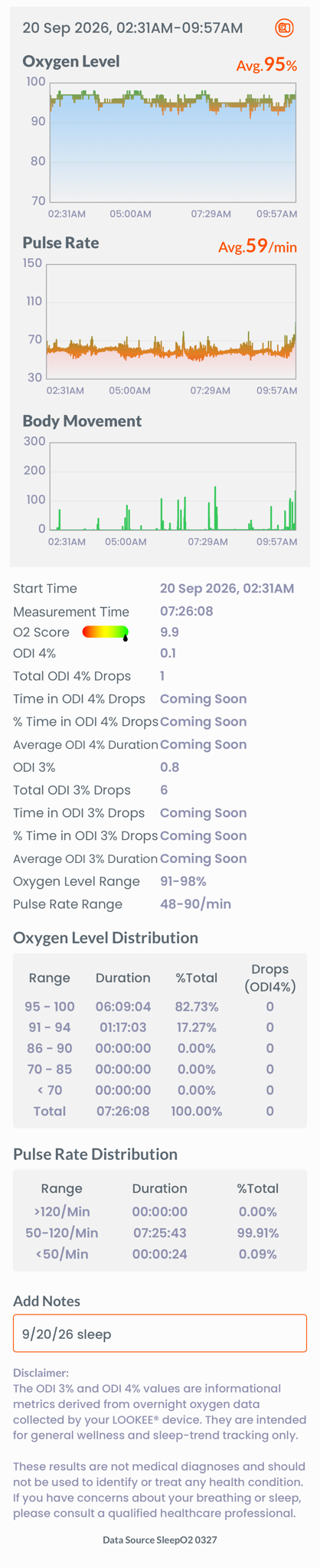
I am extremely happy to see your wonderful numbers, Larry! They are much better than my best night WITH a CPAP machine.
Not only is it reassuring, you don't to go thru a sleep study in order to find this out.
And you will have this device for as long as it lasts, which hopefully is years.
And you will be able to capture night(s) when you wake up not breathing to understand more about what is going on.
And you will know if/when you develop early stages of sleep apnea way before anybody without this device would know, which is often many years after they had it. Some people=never.
You can see how various activities or changes in your routine impact your sleep and see what the range is between your best and worst nights.
A perfect example for me was that I had one of my best nights ever last night. Staying at or above 92% O2........except at 2:30 am, I dropped to 82%.
I showed my wife and she said "maybe it's an artifact". Nope, my pulse also spiked up at that time with an increase consistent with the drop in O2. And this was with a CPAP machine. A CPAP machine is the gold standard for treating OBSTRUCTIVE sleep apnea because it keeps your airway open. Obstructive sleep apnea happens because the air way is not wide open enough for air movement.
If your brain stem stops telling you to breath, it might not matter if your airway is wide open.
A CPAP can still help because it's FORCING air into your lungs and sort of replacing the natural breathing response that isn't coming from your brain stem. 82% is the lowest reading for me with it compared to 2 dozen times at 74% with the alarm going off the previous 6 months without it.
Hey Mike et al,
Well, 5 minutes ago I woke up from a nap out of breath. Unfortunately, I didn’t have the device on. :(
Dang, you missed it, Larry!
Surely there will be other times and if it's happening this infrequently, it's probably not serious. Always good to know for sure though!
Thanks, Mike!
Well, I forgot to mention that I got both a flu and Covid shot ~8 hours prior to when I woke up out of breath. Also, I’m just over the last hour or so noticed a slight faint feeling often indicative of a mild elevation of my body temp. I took my temp and it is, indeed, mildly elevated from my normal 97.5ish temp (though not a fever), which is causing slight chills.
So, although I get similar out of breath episodes about every month or two usually without them being repetitive, my having mild side effects from the shots tells me that that could have contributed somehow.
I also should mention that I had previously planned to get a fasting insulin test as well as fasting glucose and another D-dimer tomorrow. I after doing some reading just canceled it due to the chance my results being thrown off. I’ll play it safe and wait ~2 weeks since these aren’t urgent.
Update: my temp has risen a bit further (slowly). This is supposed to be indicative of the shots working as the affect my immune system.
10:54PM CDT update: now 100.1 temp
1:30AM CDT temp 102.3, highest yet. Pulse from fever: 106. Already took 2 ES Tylenol at 12:25AM CDT. Waiting for Tylenol to start working here at 1:41AM CDT.
Shhhhhhh! Don't tell people here about the side effects from getting vaccinated
Just kidding of course.
This is a pretty normal reaction, though pretty strong from your body's immune response to the dead virus it was exposed to. I would guess that you have a pretty strong immune system that has kicked in and will be gushing out COVID and FLU antibodies for the next several months that were not there a couple of days ago.
So even if you are exposed to those virus's and get sick(which is far less likely now) your immune system won't need several days to recognize it and start antibody production.
Instead, your immune system will go into mass production from the get go and crush it before the virus can duplicate exponentially.
Virus's replicate 700 copies of themselves every 7 hours. That means in 14 hours, 1 viral unit can become 49,000 viral units.
Then it's 49,000 X 700 = 34,300,000 viral units in 21 hours.
That is, unless your body is killing them off from the get go, which is what these vaccines will equip your body to do by tricking it with dead virus cells into thinking it got invaded.
You can't get COVID or the Flu from the vaccine because they are DEAD cells.
It sucks that you feel so bad and with the fever but think of it as PROTECTION for the next 6 months and this is a powerful sign that the vaccine is doing exactly what its supposed to do.
I always get a flu and COVID shot at the same time if offered even though you/we risk having a stronger reaction like you're having. This likely impacted your breathing when you took that brief nap too.
On taking the Tylenol. It's ok AFTER the shots.
+++++++++
Getting a fever is an effective part of how our body fights pathogen's/invaders. In the past, it was thought that getting the fever down was always a good thing. Now we know that reducing the fever can impede the effectiveness of the body's natural pathogen fighting mechanisms.
Thanks, Mike.
I took the Tylenol because that level of fever was starting to make me feel miserable and I wanted to get good sleep, especially knowing I had some things I needed to do today out of the house. The 102.3 spike was quite high compared to that from prior Covid shots. The good news is that the Tylenol finally took effect soon after my last post.
My temp peaked ~102.3 ~2:30AM. Fell asleep ~3AM and woke up 7:15 sweating. My temp was way down to 98.1 and pulse in 80s (down from 108) thanks largely to Tyl that I took at night. Felt much better!
Went back to sleep and temp rose back to 100.8 ~10:30AM. Pulse went back up some to low 90s. So took 2 more TYL so I’d feel good enough to go out and do the things I needed to do. And I’ve felt pretty good ever since. Temp now only 98.1 and that’s 7 hours after my last Tylenol.
Thanks, Larry!
I totally get you taking the Tylenol.
That seems like a pretty powerful reaction to the vaccines, even though taking 2 at the same time will amplify that impact.
I would assume that this likely means you have a great immune system if I was an expert but I'm not so I'll just guess that it means you have a great immune system.
AI Overview
Some people have a stronger reaction to vaccines because their innate immune systems are more active and reactive before they even receive the shot. [1, 2]Most users on Reddit agree that individual immune variability plays a major role. Temporary side effects like fever, fatigue, and arm pain—known as reactogenicity—are signs that your immune system is hard at work. [1, 2, 3]Key Factors Causing Stronger Vaccine Reactions
Thanks, Mike!
That’s interesting about interferons, which I don’t recall knowing about those before. I do know that my lymphocytes have been on the very low end of normal for ~8 years. Thus, I worry about both being extra vulnerable to catching a virus and any viral infection being stronger than average. That’s why I decided to get both shots.
But your research suggests I have high levels of interferons, which are supposed to be like watchers to tell the lymphocytes to attack viruses.