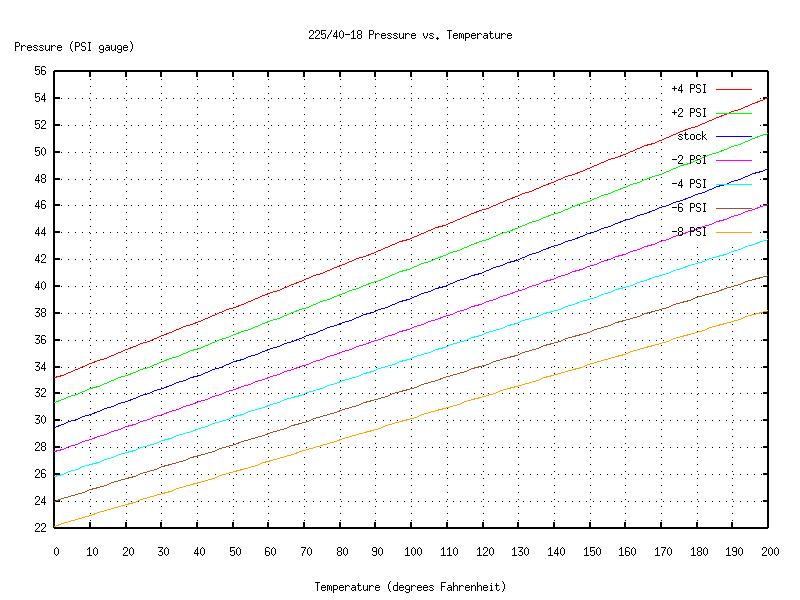
I just inflated the air pressure in my wife's vehicle because the sensor lights came on. With her Toyota Corolla the pressure in the rear tires should be 33 psi and 35 psi in the front tires. The pressure had dropped to 30 psi from the temperatures dropping.
https://www.13abc.com/2023/01/03/moment-science-air-temperature-vs-tire-pressure/
++++++++++
I still remember the Idea Gas Law, that we used constantly in Atmospheric and Oceanic Science at the University of Michigan!!
This one is for gases only. However, physical laws that all FLUIDS obey often apply to both gases and liquids, which are both fluids.
https://www.arden.org/misc/pressure.html
Let's take a look at the graph with pressure on the y(vertical axis) and temperature on the x(horizontal axis) below.
1. Note only the temperature range from 0 Deg. F on the far left to 100 Deg. F in the center to represent the temperature extremes that your car might be driving in. Clearly the low/high temps would not last long.
2. Let's pick the blue line in the center to see the specific changes. On the left, at 0 Deg. F the pressure is at around 30 psi on the blue line. Boosting the temperature to 100 Deg. F causes the pressure to go to 39 psi, an increase of 9 psi. This equates to an increase of .9 psi for every +10 Deg. F. (roughly 1 psi/10 degrees).
3. Using the average July temperature of around 80 degrees in July in Evansville, IN to the average temp in January of around 30 degrees equates to a drop in tire pressure of around 5 psi.
4. There will be heat waves and cold waves and wild fluctuations all year round and you can't change your tire pressure every time the temperature drops or goes up by 30+ in a short time span. However, an AVERAGE variation of 5 psi from Summer to Winter is plenty enough to change the air pressure in your tires at least 2 times/year.
5. An alternative, which most people accept is to have the air pressure in their tires OVER inflated by a bit in the Summer, then UNDER inflated by a bit in the Winter.
Regardless of that, the graph below demonstrating the change in air pressure from the Ideal Gas Law is very impressive and good to understand.